Last updated: 14 November 2026
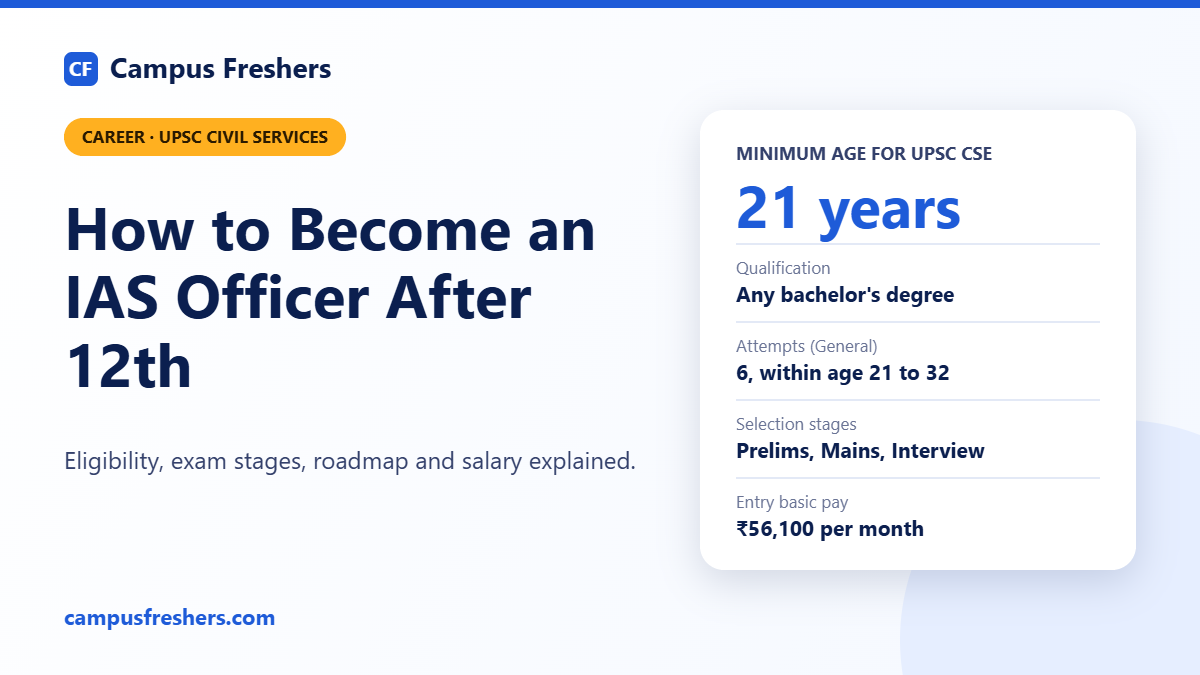
Quick answer: You cannot write the UPSC Civil Services Exam straight after Class 12, because you need a bachelor’s degree and must be at least 21. What you can do after 12th is pick a degree you enjoy, build reading and writing habits, and plan to attempt the CSE in your final year or soon after graduation.
Key highlights
- Exam: UPSC Civil Services Examination (CSE), held once a year
- Minimum qualification: a bachelor’s degree in any stream from a recognised university (final-year students can apply)
- Age limit (CSE 2026): 21 to 32 years for General and EWS, with relaxation for OBC, SC, ST and PwBD candidates
- Attempts: 6 for General and EWS, 9 for OBC, unlimited for SC and ST within the age limit
- Three stages: Prelims, Mains (1,750 marks) and Personality Test (275 marks)
- Entry-level basic pay of an IAS officer: ₹56,100 per month under the 7th Pay Commission, plus allowances
Can I become an IAS officer right after 12th?
Not directly. The Indian Administrative Service (IAS) is filled through the UPSC Civil Services Examination, and the CSE needs a graduation degree and a minimum age of 21. So the journey after 12th is really a graduation plus preparation journey of three to five years. The good news: there is no required stream. Science, commerce, arts, engineering, medicine or law graduates are all eligible.
Many toppers start serious preparation in the second or third year of college. Starting early does not mean studying 12 hours a day from Class 12. It means reading a newspaper daily, understanding NCERT basics, and choosing a degree you can do well in.
What is the eligibility for the UPSC Civil Services Exam?
The table below is based on the CSE 2026 notification. UPSC publishes a fresh notification every year, so always check the latest one before you apply.
| Category | Age limit (CSE 2026) | Number of attempts |
|---|---|---|
| General / EWS | 21 to 32 years | 6 |
| OBC | Up to 35 years | 9 |
| SC / ST | Up to 37 years | Unlimited (within age limit) |
| PwBD | Up to 42 years | As per category rules |
For CSE 2026, candidates had to be born between 2 August 1994 and 1 August 2005 (General category). Only Indian citizens can join the IAS, IPS and IFS. Final-year students can apply provisionally but must show proof of passing their degree by the interview stage.
How does the UPSC selection process work?
The CSE has three stages. Each stage filters candidates for the next one, and only Mains and the interview count in the final merit list.
| Stage | What it includes | Marks |
|---|---|---|
| Prelims (objective) | GS Paper 1 (100 questions) and CSAT Paper 2 (80 questions); CSAT is qualifying at 33%; one-third negative marking | 200 + 200 (only GS Paper 1 decides the Mains cut-off) |
| Mains (descriptive) | Essay, GS 1 to 4, two optional papers, plus two qualifying language papers (Indian language and English, 300 marks each) | 1,750 for merit |
| Personality Test | Interview at UPSC, Dholpur House, New Delhi | 275 |
| Final merit | Mains + Interview | 2,025 |
To get a sense of the competition: in the 2026 cycle, UPSC notified about 933 vacancies, and 2,526 candidates qualified the Mains for the interview round when results came out on 5 November 2026. That is why consistency over years matters more than last-minute effort.
Which degree should I choose after 12th for IAS?
There is no “best” degree for IAS. Choose one where you can score well and that gives you a backup career. A few practical pointers:
- BA in History, Political Science, Geography, Sociology or Economics: overlaps strongly with the GS syllabus and popular optional subjects.
- B.Sc or B.Tech: builds analytical skills useful for CSAT, and gives a strong job fallback.
- B.Com or BBA: helps with economy topics; Commerce and Accountancy is also an optional subject.
- LLB (5-year): useful for polity and governance, and Law is an optional subject.
Remember that a 5-year integrated course pushes your first possible attempt later. That is fine, but plan for it.
How to become an IAS officer after 12th: a step-by-step roadmap
| Stage | What to do |
|---|---|
| After Class 12 | Join a degree you like. Start reading one national newspaper daily and keep short notes. |
| College Year 1 | Read NCERT books (Class 6 to 12) for History, Geography, Polity and Economy. Improve English and Hindi or regional language writing. |
| College Year 2 | Study the official UPSC syllabus and previous year papers. Shortlist an optional subject based on interest and your degree. |
| College Year 3 | Begin standard books for GS, practise answer writing weekly, and solve CSAT papers to make sure you clear 33% comfortably. |
| Final year or after graduation | Apply when the notification is out, write Prelims, and keep a full-time plan of revision, mocks and Mains answer writing. |
What is the salary of an IAS officer?
IAS pay follows the 7th Central Pay Commission. Basic pay starts at ₹56,100 per month, and officers also get dearness allowance, house rent allowance or government housing, travel allowance and other benefits. Indicative basic pay as you grow:
| Typical post (example) | Basic pay per month |
|---|---|
| Sub-Divisional Magistrate (entry level) | ₹56,100 |
| Additional District Magistrate | ₹67,700 |
| District Magistrate (early) | ₹78,800 |
| Divisional Commissioner / Joint Secretary level | ₹1,44,200 |
| Chief Secretary / Secretary to GoI | ₹2,25,000 |
| Cabinet Secretary | ₹2,50,000 |
Actual take-home pay depends on allowances and posting. Pay may change if a new pay commission is implemented, so treat these as indicative figures.
Is the IAS career right for you?
- It suits you if you enjoy reading about society, economy and governance, can write clearly, and want work with public impact.
- Be ready for a long, uncertain exam cycle. Prelims, Mains and the interview together take about a year, and many candidates need more than one attempt.
- Always keep a Plan B: a good degree, a skill, or another exam (state PSC, banking, SSC) protects you if things take longer.
- Look after yourself: sleep, exercise and talking to family and friends help you last the distance.
FAQs on becoming an IAS officer after 12th
Can I apply for UPSC in my final year of graduation?
Yes. Final-year students can apply provisionally and write Prelims, as long as they are at least 21. They must submit proof of passing the degree by the time of the interview.
Do I need high marks in Class 12 or graduation for IAS?
No minimum percentage is required. You only need a degree from a recognised university. Good marks still help with a backup career.
Is coaching compulsory to crack the UPSC CSE?
No. Many candidates prepare on their own using NCERTs, standard books, newspapers and online test series. Coaching can give structure, but self-discipline matters most.
Can I write the UPSC exam in Hindi or my regional language?
Prelims papers are in Hindi and English. For Mains and the interview, UPSC allows several Indian languages listed in the Eighth Schedule, as per the notification. Check the latest notification for the exact rules.
How many hours a day should I study for IAS?
During college, two to three focused hours a day are enough. In the final full-time phase, most aspirants study six to eight hours with regular breaks and revision.
When does UPSC release the CSE notification?
UPSC follows its annual exam calendar. The CSE 2026 notification came on 4 February 2026 and Prelims was held on 24 May 2026. Check upsc.gov.in for the 2027 dates.
Official links and sources
- UPSC: Civil Services Examination 2026 notification page
- UPSC online application portal (upsconline.nic.in)
- ClearIAS: UPSC CSE 2026 notification summary
- Careers360: IAS exam pattern
- Careers360: UPSC CSE Mains 2026 result
- Careers360: IAS salary structure