Last updated: 14 November 2026
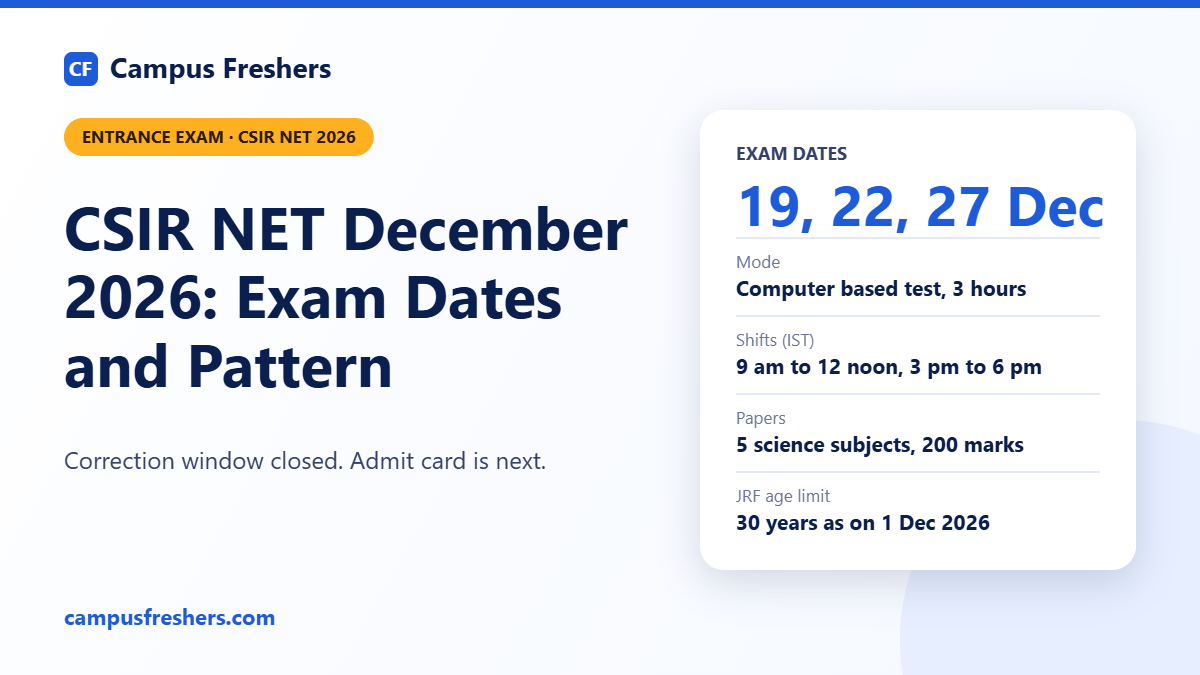
Quick answer: The Joint CSIR-UGC NET December 2026 will be held on 19, 22 and 27 December 2026 as a computer based test, in two shifts a day, as per NTA’s information bulletin. Registration and the correction window (10 to 12 November) are now closed. The exam city slip and admit card dates will be announced later, so the next five weeks are for revision and mock tests.
Key highlights
- Exam dates: 19, 22 and 27 December 2026 (CBT, 3 hours, Hindi and English)
- Shift timings: 9:00 am to 12:00 noon and 3:00 pm to 6:00 pm IST
- Five subjects: Chemical Sciences, Earth Sciences, Life Sciences, Mathematical Sciences and Physical Sciences
- Every paper has Parts A, B and C for a total of 200 marks, with negative marking in most parts
- JRF age limit: not more than 30 years as on 1 December 2026, with up to 5 years of relaxation for eligible groups
- JRF fellowship: ₹37,000 per month for the first two years, as per the bulletin
When is CSIR NET December 2026?
The National Testing Agency (NTA) will conduct the exam on three days: 19, 22 and 27 December 2026. Each day has two shifts. The subject-wise schedule, your exam city and your exact shift will be shared closer to the exam, so keep checking the official portal and your registered email.
| Event | Date |
|---|---|
| Online registration | 7 October to 5 November 2026 |
| Late submission (with ₹500 late fee) | 6 to 9 November 2026 |
| Correction window | 10 to 12 November 2026 (closed) |
| Exam city intimation slip | To be announced |
| Admit card | To be announced |
| CSIR NET December 2026 exam | 19, 22 and 27 December 2026 |
| Answer key and result | To be announced |
Shift 1 runs from 9:00 am to 12:00 noon and Shift 2 from 3:00 pm to 6:00 pm IST. Reach the centre well before the reporting time printed on your admit card.
What is the CSIR NET exam pattern and marking scheme?
Every subject paper has three parts. Part A tests general aptitude and is common in style across subjects. Parts B and C test your subject, with Part C carrying higher-level, analytical questions. You do not have to attempt every question: only a fixed number per part is evaluated, and the bulletin says the first questions you answer, up to that limit, are the ones counted.
| Subject | Questions to attempt (A / B / C) | Marks per correct answer (A / B / C) | Negative marking |
|---|---|---|---|
| Chemical Sciences | 15 / 35 / 25 | 2 / 2 / 4 | 25% in all parts |
| Earth, Atmospheric, Ocean and Planetary Sciences | 15 / 35 / 25 | 2 / 2 / 4 | 25% in A and B, 33% in C |
| Life Sciences and Biotechnology | 15 / 35 / 25 | 2 / 2 / 4 | 25% in all parts |
| Mathematical Sciences | 15 / 25 / 20 | 2 / 3 / 4.75 | 25% in A and B, none in C |
| Physical Sciences | 15 / 20 / 20 | 2 / 3.5 / 5 | 25% in all parts |
One special rule for Mathematical Sciences: in Part C, a question may have more than one correct option, and you get marks only if you select all the correct options. There is no separate sectional cut-off. As per the bulletin, the minimum benchmark is 33% aggregate for General, EWS and OBC candidates and 25% for SC, ST and PwD/PwBD candidates, but the final cut-offs for JRF, Assistant Professor and PhD admission are decided after the exam. Always confirm cut-offs and results on the official website.
Who is eligible and what is the JRF age limit?
The usual route is a Master’s degree (M.Sc or equivalent) with at least 55% marks for General and EWS candidates, or 50% for OBC-NCL, SC, ST, PwD/PwBD and Third Gender candidates. Marks are counted without rounding off. Final-year students and those awaiting results could apply provisionally, but must meet the percentage condition later as per the bulletin.
Students of four-year bachelor’s degree programmes with at least 75% aggregate (with relaxation for eligible categories) can qualify for JRF and PhD admission, but not for Assistant Professor eligibility.
| Category of qualification | Upper age limit |
|---|---|
| Junior Research Fellowship (JRF) | 30 years as on 1 December 2026 (up to 5 years relaxation for OBC-NCL, SC, ST, PwD/PwBD, Third Gender and women candidates) |
| Assistant Professor | No upper age limit |
| PhD admission only | No upper age limit |
For the fee side, applicants paid ₹1,150 (General), ₹600 (EWS and OBC-NCL) or ₹325 (SC, ST, PwD/PwBD and Third Gender). Those who qualify for JRF receive ₹37,000 per month for the first two years plus a ₹20,000 annual contingency grant, and can move to SRF at ₹42,000 per month from the third year, subject to review and PhD registration.
What happens next after the correction window?
The correction window closed on 12 November 2026 at 11:50 pm, and NTA has said no further changes will be allowed after it. The next official updates will be the advance exam city intimation slip and then the admit card. Both will be available only on csirnet.nta.nic.in through your login. NTA does not send admit cards by post.
What should aspirants do next? A 5-week plan
Five weeks is enough to sharpen what you already know. It is not the time to start new, heavy topics from zero. Here is a simple plan you can adapt to your subject.
| Week | Focus |
|---|---|
| Week 1 (15 to 21 Nov) | List your strong and weak units. Revise high-scoring Part B units first. Do 20 Part A aptitude questions daily. |
| Week 2 (22 to 28 Nov) | Solve two previous year papers under exam timing. Mark mistakes and revise those concepts the same day. |
| Week 3 (29 Nov to 5 Dec) | Move to Part C practice. Choose the question types you can attempt with confidence. |
| Week 4 (6 to 12 Dec) | Take full-length mocks every two days. Fix your attempt order (for example Part A, then B, then C). |
| Week 5 (13 Dec onward) | Light revision, formula sheets, one last mock, and download your admit card as soon as it is out. |
- Respect negative marking: in most parts a wrong answer costs 25% of the question’s marks, so skip pure guesses.
- Attempt only what counts: since only a fixed number of answers per part is evaluated, answering extra questions does not help.
- Practise on screen: CBT feels different from paper. Use NTA style online mocks.
- Keep documents ready: a valid photo ID and your admit card printout will be needed on exam day.
FAQs on CSIR NET December 2026
When will the CSIR NET December 2026 admit card be released?
NTA has not announced the date yet. The bulletin says the city intimation slip and admit card dates will be announced later. Usually the city slip comes first, followed by the admit card a few days before the exam.
Can I still edit my CSIR NET application form?
No. The correction window ran from 10 to 12 November 2026 and has closed. NTA does not accept corrections by email, post or WhatsApp.
Is there negative marking in CSIR NET?
Yes, in most parts. It is generally 25% of the marks for that question, 33% in Part C of Earth Sciences, and there is no negative marking in Part C of Mathematical Sciences.
What is the age limit for JRF in CSIR NET December 2026?
You must not be older than 30 years as on 1 December 2026. Eligible categories, including women candidates, get up to 5 years of relaxation. There is no upper age limit for Assistant Professor or PhD admission.
How much is the JRF stipend?
As per the information bulletin, JRF is ₹37,000 per month for the first two years with a ₹20,000 yearly contingency grant. It can be upgraded to SRF at ₹42,000 per month from the third year.
Is CSIR NET the same as UGC NET?
No. CSIR NET covers five science subjects, while UGC NET covers humanities, social sciences, commerce and other subjects. Both are conducted by NTA and have separate December 2026 schedules.
Official links and sources
- Joint CSIR-UGC NET official portal (csirnet.nta.nic.in)
- Information Bulletin, Joint CSIR-UGC NET December 2026 (PDF)
- NTA public notice on correction window, 10 November 2026 (PDF)
- CareerIndia: CSIR UGC NET December 2026 correction window
Helpline as listed in the bulletin: 011-40759000 / 011-69227700, email csirnet@nta.ac.in.
