Last updated: 13 November 2026
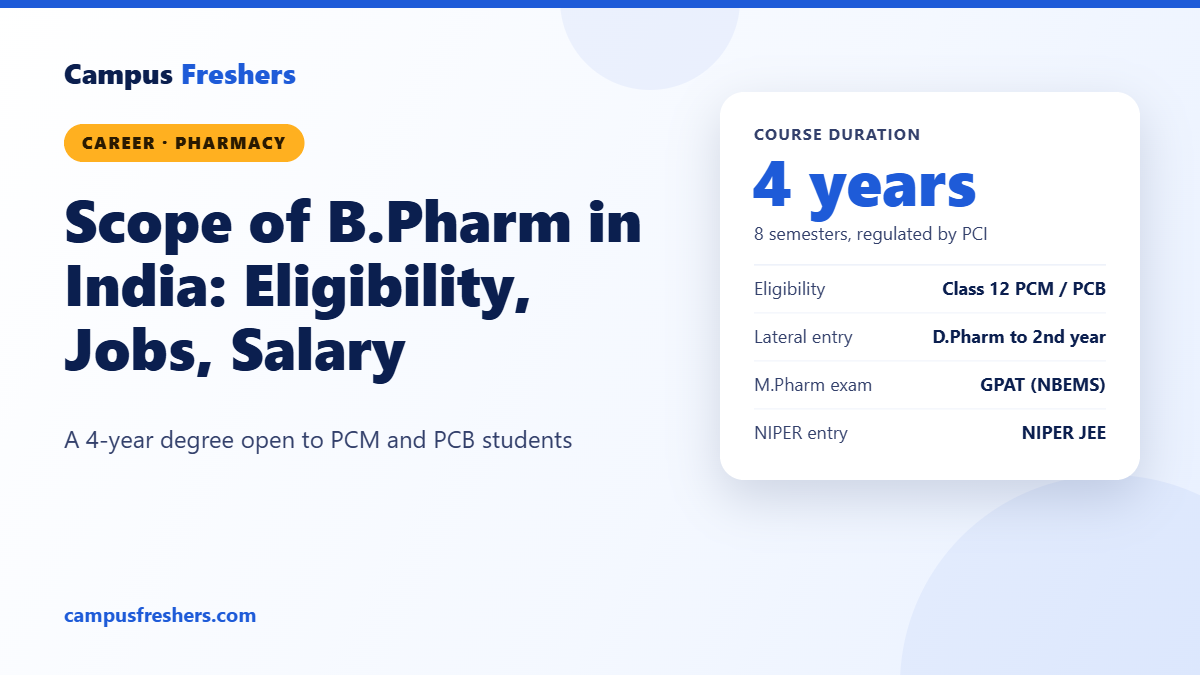
Quick answer: B.Pharm is a four-year, eight-semester degree regulated by the Pharmacy Council of India (PCI). You can join after Class 12 with Physics and Chemistry plus Maths and/or Biology. Graduates work as pharmacists, in pharma companies (production, quality, regulatory, sales) or as drug inspectors, and can study further through GPAT or NIPER JEE.
Key highlights
- Course: Bachelor of Pharmacy (B.Pharm), 4 years, 8 semesters
- Eligibility: Class 12 with English, Physics, Chemistry and Maths and/or Biology
- Lateral entry: D.Pharm holders from PCI-approved institutes can join directly in the second year
- Admission: state entrance tests (such as WBJEE, TS EAMCET, AP EAMCET, BCECE) or college merit lists
- Higher studies: M.Pharm through GPAT (conducted by NBEMS), MS (Pharm) and M.Pharm at NIPERs through NIPER JEE
- Common jobs: pharmacist, production and quality control, regulatory affairs, medical representative, drug inspector
What is B.Pharm and who regulates it?
B.Pharm (Bachelor of Pharmacy) is the main undergraduate degree for anyone who wants to work with medicines: how they are made, tested, stored, sold and used safely. The course covers pharmaceutics, pharmaceutical chemistry, pharmacology, pharmacognosy (medicines from natural sources), and the laws that govern drugs in India.
Pharmacy education in India is regulated by the Pharmacy Council of India under the Pharmacy Act, 1948. Before you take admission, check that the college and its B.Pharm course are approved by PCI for that academic year. An unapproved course can create problems later when you register as a pharmacist or apply for government jobs.
What is the eligibility for B.Pharm?
The basic rule is a Class 12 pass in the science stream. Exact minimum marks differ by state and college, so always read the admission brochure of the state counselling body or university you are applying to.
| Route | Eligibility | Duration |
|---|---|---|
| B.Pharm (regular) | Class 12 with English, Physics, Chemistry, and Maths and/or Biology (PCM, PCB or PCMB) | 4 years (8 semesters) |
| B.Pharm (lateral entry) | D.Pharm from a PCI-approved institution; admitted to second year | 3 years |
| D.Pharm | Class 12 science; diploma that qualifies you to register as a pharmacist | 2 years |
| Pharm.D | Class 12 science; a clinical pharmacy doctorate-level programme | 6 years (including internship) |
Good news for Maths students: you do not need Biology for B.Pharm in most states. PCM students are eligible alongside PCB students, which makes pharmacy one of the few health-science degrees open to both groups.
How do you get admission to B.Pharm?
There is no single national entrance test for B.Pharm. Most government and many private seats are filled through state-level exams and counselling. Examples include WBJEE (West Bengal), TS EAMCET (Telangana), AP EAMCET (Andhra Pradesh) and BCECE (Bihar). Some private universities run their own tests, and some colleges admit students on Class 12 marks.
Fees vary widely. A government college seat usually costs far less than a private one, and private college fees for the full course commonly run into several lakh rupees. Compare the total cost (tuition, hostel, exam fees) before you lock a seat.
What is the scope of B.Pharm in India?
India has a large pharmaceutical manufacturing sector and a huge network of hospitals and retail pharmacies, so B.Pharm graduates have options in industry, healthcare and government. Here are the main paths:
| Career path | What you do | Where you work |
|---|---|---|
| Registered pharmacist | Dispense medicines, guide patients on dosage and side effects | Hospitals, retail chains, your own pharmacy |
| Production and quality control | Manufacture medicines, test batches for quality and safety | Pharma companies and contract manufacturers |
| Regulatory affairs | Prepare documents for drug approvals and compliance | Pharma companies, regulatory consultancies |
| Medical representative / sales | Explain products to doctors and pharmacies | Pharma marketing teams |
| Clinical research and pharmacovigilance | Support drug trials, track and report side effects | CROs, pharma companies |
| Drug inspector | Inspect manufacturers and pharmacies, enforce drug laws | Central and state drug control departments (through recruitment exams) |
To run a pharmacy or work as a pharmacist, you must register with your State Pharmacy Council after completing a recognised D.Pharm or B.Pharm. Many graduates also start their own medical store a few years into their career.
How much do B.Pharm graduates earn?
Starting pay depends heavily on the role, city and employer. Careers360 lists typical figures of about ₹2.2 lakh per year for a pharmacist, about ₹2.4 lakh for a health inspector and about ₹10 lakh for a drug inspector, with an average B.Pharm package in the ₹2 lakh to ₹5 lakh range. Treat these as rough guides, not promises.
Salaries tend to rise faster when you add a specialisation (M.Pharm, regulatory affairs, clinical research) or move into roles such as quality assurance, formulation development or management.
What can you study after B.Pharm?
- M.Pharm through GPAT: The Graduate Pharmacy Aptitude Test is conducted by the National Board of Examinations in Medical Sciences (NBEMS) for M.Pharm admissions. GPAT 2026 was held on 7 March 2026 in 114 cities as a computer-based test.
- NIPER JEE: The National Institutes of Pharmaceutical Education and Research (NIPERs) admit students to MS (Pharm), M.Pharm and other programmes through NIPER JEE. GPAT ranks are also used at some NIPERs.
- MBA (Pharma or general): Good for sales, marketing, product management and business roles.
- PhD: For research and teaching careers.
- Study abroad: Some students pursue an MS in pharmaceutical sciences or related fields overseas.
Is B.Pharm the right course for you?
B.Pharm could suit you if:
- You enjoy Chemistry and want to understand how medicines work.
- You want a health-care career but are not keen on (or did not clear) MBBS.
- You took PCM and still want to work in the medical field.
- You like lab work, careful documentation and following rules precisely.
- You are open to further study, since an M.Pharm or specialisation often opens better roles.
It may not be the best fit if you dislike lab work, memorising drug names and regulations, or if you expect a high salary immediately after graduation without further study or skill building.
FAQs on B.Pharm
Can a PCM student do B.Pharm?
Yes. Class 12 with Physics, Chemistry and Maths is accepted for B.Pharm in most states. Check the specific state or university brochure, since rules on subject combinations and minimum marks can differ.
Is NEET required for B.Pharm?
Generally no. B.Pharm admissions are usually through state entrance exams, university tests or Class 12 merit. A few institutions or states may consider other scores, so read the admission notice carefully.
What is the difference between D.Pharm and B.Pharm?
D.Pharm is a 2-year diploma focused on dispensing and pharmacy practice. B.Pharm is a 4-year degree with deeper science and industry training. D.Pharm holders can later join B.Pharm in the second year through lateral entry.
Can I open my own medical store after B.Pharm?
Yes, after you register as a pharmacist with your State Pharmacy Council and obtain the required drug licence from the state drug control department. The licensing rules are set by the state, so check the local requirements.
Which exam should I take for M.Pharm?
GPAT, conducted by NBEMS, is the main national exam for M.Pharm admissions. For the NIPERs, you will also need to look at NIPER JEE. Keep an eye on natboard.edu.in for the GPAT 2027 notice.
Is B.Pharm better than B.Sc?
Neither is better for everyone. B.Pharm is a professional degree with a clear licence-based career (pharmacist) and strong industry links, while a B.Sc is broader and suits students aiming for research or teaching. Choose based on the work you actually want to do.
Official links and sources
- Pharmacy Council of India (PCI)
- National Board of Examinations in Medical Sciences (GPAT)
- HSTES: B.Pharm and lateral entry eligibility (example state admission body)
- Careers360: GPAT 2026 exam on 7 March in 114 cities
- Careers360: B.Pharm course, entrance exams and salary figures