Choosing the right postgraduate program can play an important role in shaping your professional future. An M.Sc. (Master of Science) is a two-year postgraduate degree designed for students who want to deepen their scientific knowledge, develop practical and analytical skills, and prepare for careers in research, technology, healthcare, industry and other emerging sectors.
With rapid advancements in biotechnology, data science, cybersecurity, chemistry, microbiology, forensic science and healthcare, there is growing demand for professionals who combine strong subject knowledge with practical problem-solving abilities.
An M.Sc. program can provide students with an opportunity to move beyond undergraduate-level learning and develop specialized expertise that can support both career growth and further research studies.
Why Choose an M.Sc.?
An M.Sc. is more than an advanced academic qualification. It can help students develop skills that are relevant to modern scientific and technology-driven workplaces.
Key benefits include:
- Specialized knowledge: Gain deeper expertise in a chosen scientific or technology discipline.
- Research skills: Learn how to investigate problems, analyze information and develop evidence-based solutions.
- Practical exposure: Laboratory work, projects, case studies and practical training can help connect classroom concepts with real-world applications.
- Analytical thinking: Develop logical, quantitative and problem-solving abilities that are valuable across industries.
- Career flexibility: Depending on the specialization, graduates can explore opportunities in laboratories, healthcare, pharmaceuticals, IT, research organizations, manufacturing, cybersecurity, data-driven businesses and more.
- Higher studies: An M.Sc. can provide a foundation for pursuing Ph.D. programs, research careers and other advanced qualifications.
- Interdisciplinary learning: Modern scientific challenges increasingly require knowledge from multiple disciplines, making interdisciplinary skills particularly valuable.
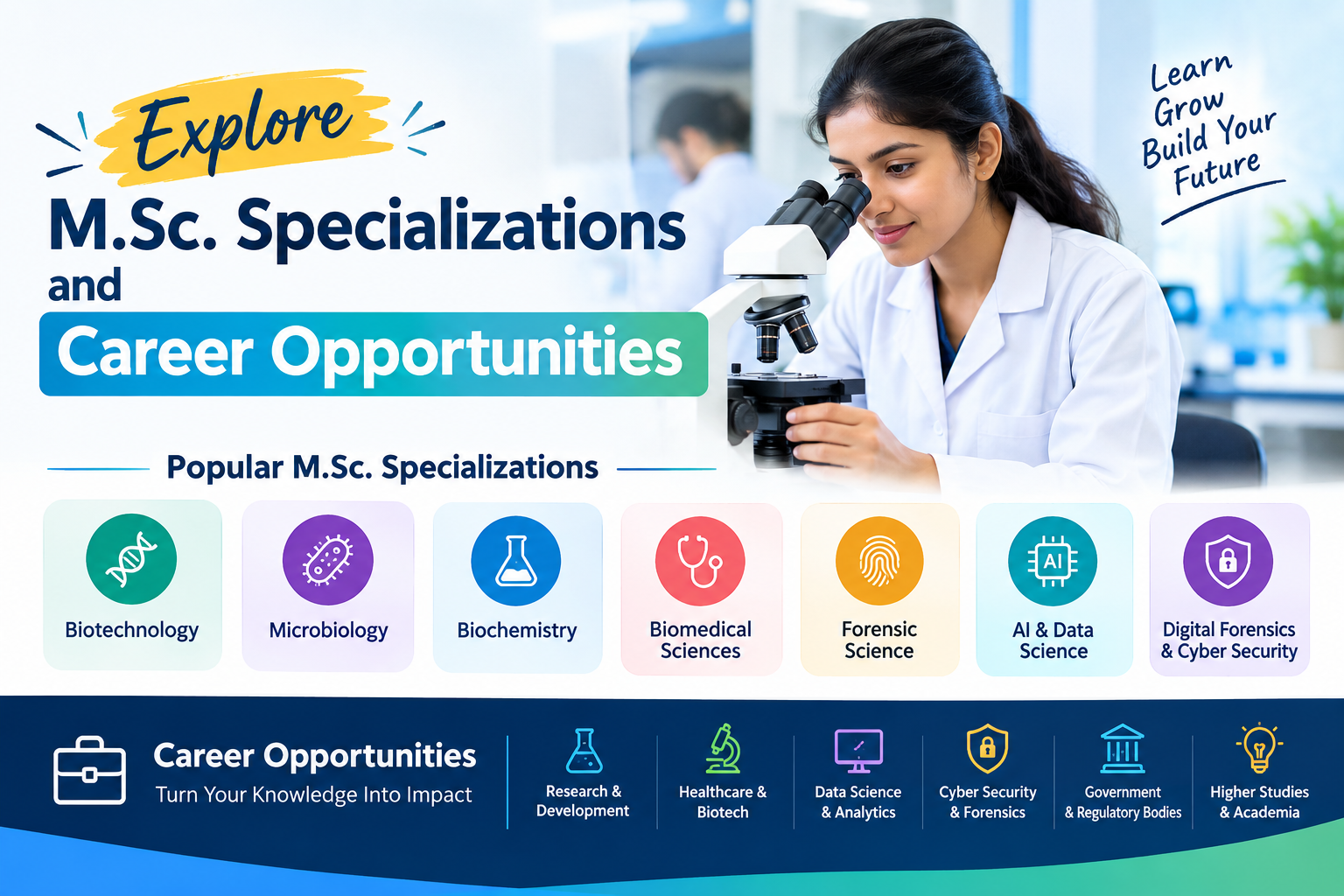
Explore M.Sc. Specializations and Career Opportunities
1. M.Sc. Biotechnology
Biotechnology combines biology with technology to develop applications across healthcare, pharmaceuticals, agriculture, food technology and environmental science.
An M.Sc. in Biotechnology can help students develop knowledge of areas such as molecular biology, genetic engineering, cell biology, bioinformatics and laboratory techniques.
Career areas may include:
- Biotechnology companies
- Pharmaceutical and healthcare organizations
- Research laboratories
- Molecular biology laboratories
- Food and agricultural biotechnology
- Clinical research
- Quality control and testing
- Academic and research institutions
Students interested in research and advanced scientific applications can also consider pursuing doctoral studies after completing their M.Sc.
2. M.Sc. Biotechnology (DBT Supported)
A DBT-supported M.Sc. Biotechnology program offers students an opportunity to pursue advanced education in biotechnology with an emphasis on modern biological sciences and research-oriented learning.
The field can be relevant to students interested in areas such as molecular biology, genetics, biotechnology research, pharmaceutical applications and life sciences.
Potential career pathways include:
- Biotechnology research
- Pharmaceutical industries
- Clinical research
- Molecular diagnostics
- Research laboratories
- Academic institutions
- Bioinformatics and life-science applications
For students interested in scientific research and innovation in the life sciences, this specialization can provide a strong postgraduate foundation.
3. M.Sc. Chemistry – Analytical
Analytical chemistry focuses on identifying, measuring and studying the composition of substances. It has applications across pharmaceuticals, chemicals, food, environmental testing and manufacturing.
Students can develop knowledge of analytical techniques, instrumentation, laboratory analysis and quality assessment.
Career opportunities can include:
- Analytical laboratories
- Pharmaceutical companies
- Chemical industries
- Quality testing laboratories
- Environmental testing
- Food and beverage testing
- Research and development
- Quality assurance and quality control
Analytical chemistry is particularly relevant for students interested in laboratory-based careers and scientific testing.
4. M.Sc. Chemistry – Organic
Organic chemistry focuses on the structure, properties and reactions of carbon-based compounds. It has an important role in pharmaceuticals, chemicals, polymers, materials and research.
An M.Sc. in Organic Chemistry can help students develop advanced laboratory and research skills.
Career areas may include:
- Pharmaceutical research
- Chemical industries
- Research and development
- Laboratory analysis
- Manufacturing
- Quality control
- Academic research
- Further studies and doctoral research
Students interested in laboratory research and chemical product development can explore opportunities in both industry and academia.
5. M.Sc. Chemistry – Quality Control
Quality control is essential in industries where products must meet defined standards for safety, consistency and performance.
This specialization can help students understand chemical testing, laboratory procedures, analytical techniques and quality standards.
Career opportunities may be available in:
- Pharmaceutical companies
- Chemical manufacturing
- Food and beverage industries
- Quality control laboratories
- Testing facilities
- Manufacturing organizations
- Research and development
- Quality assurance departments
This field can be particularly suitable for students who enjoy laboratory work and systematic analysis.
6. M.Sc. Microbiology
Microbiology focuses on microorganisms and their interactions with humans, animals, plants and the environment. It has applications in healthcare, pharmaceuticals, food technology, biotechnology and environmental science.
Students can gain knowledge in areas such as bacteriology, virology, immunology, microbial genetics and laboratory techniques.
Career pathways may include:
- Clinical and diagnostic laboratories
- Pharmaceutical industries
- Biotechnology companies
- Food microbiology
- Quality control
- Environmental microbiology
- Research laboratories
- Academic institutions
Microbiology can also provide a foundation for advanced research in life sciences and healthcare-related fields.
7. M.Sc. Clinical Embryology
Clinical embryology is a specialized area associated with reproductive medicine and assisted reproductive technologies.
The field combines biological sciences with laboratory-based clinical practices. Students interested in reproductive biology, embryology and fertility-related laboratory work can explore this specialization.
Potential career areas include:
- Fertility and reproductive medicine centers
- IVF laboratories
- Embryology laboratories
- Reproductive biology research
- Clinical research
- Academic and research institutions
As a specialized discipline, clinical embryology can be an option for students seeking a focused career pathway within reproductive healthcare and laboratory science.
8. M.Sc. Forensic Science
Forensic science applies scientific methods to the investigation and examination of evidence. It brings together concepts from chemistry, biology, analytical science and other disciplines.
Students may study areas such as forensic biology, forensic chemistry, toxicology, questioned documents and evidence analysis.
Career areas may include:
- Forensic laboratories
- Scientific investigation
- Crime laboratories
- Evidence analysis
- Toxicology laboratories
- Research organizations
- Private forensic services
- Academic and research institutions
Students interested in applying science to evidence examination and investigative processes can consider forensic science as a specialized postgraduate pathway.
9. M.Sc. Data Science
Data is transforming how organizations make decisions, identify patterns and solve problems. Data science combines statistics, mathematics, programming and analytical methods to extract useful insights from data.
An M.Sc. in Data Science can help students build capabilities in data analysis, statistical modelling, programming, machine learning and data visualization.
Career opportunities may include:
- Data Analyst
- Data Scientist
- Business Intelligence Analyst
- Data Engineer
- Machine Learning roles
- Research and analytics
- Technology companies
- Consulting and business analytics
For students who enjoy mathematics, programming and problem-solving, data science can open pathways into the rapidly evolving digital economy.
10. M.Sc. Information Technology
Information Technology continues to play an important role across virtually every industry. An M.Sc. in IT can provide advanced knowledge of computing, software, databases, networks and information systems.
Students can develop technical and analytical capabilities applicable to a range of technology roles.
Career areas may include:
- Software and technology companies
- IT services
- System administration
- Database management
- Network technology
- Cloud and digital services
- IT consulting
- Application and software development
The degree can also serve as a foundation for students interested in advanced computing studies and technology research.
11. M.Sc. Digital Forensics and Cyber Security
As organizations increasingly depend on digital systems, protecting information and investigating digital incidents have become important areas of technology.
An M.Sc. in Digital Forensics and Cyber Security can introduce students to cybersecurity principles, digital evidence, incident investigation, cybercrime analysis and information security.
Career pathways may include:
- Cybersecurity
- Digital forensics
- Security operations
- Cybercrime investigation
- Incident response
- Information security
- Security analysis
- Digital evidence examination
This specialization can be particularly relevant for students interested in the intersection of technology, investigation and information security.
Which M.Sc. Specialization Should You Choose?
The right specialization depends on your academic interests, strengths and long-term career plans.
If you enjoy biology and life sciences, Biotechnology or Microbiology may be worth exploring. Students interested in chemistry and laboratory analysis can consider Analytical Chemistry, Organic Chemistry or Quality Control.
Those interested in healthcare and reproductive science can explore Clinical Embryology, while students interested in investigation and evidence analysis may consider Forensic Science.
For students interested in mathematics, programming and technology, Data Science, Information Technology, and Digital Forensics & Cyber Security provide different pathways into the digital sector.
Build Skills Beyond the Classroom
A successful M.Sc. journey is not only about earning a postgraduate degree. Students can use their time to develop practical skills that complement their academic knowledge.
Depending on the specialization, useful areas to explore include:
- Research methodology
- Laboratory techniques
- Data analysis
- Programming
- Scientific communication
- Problem-solving
- Technical documentation
- Project management
- Industry internships
- Presentation and communication skills
Combining subject expertise with practical and professional skills can help graduates approach the job market with a broader skill set.
Career After M.Sc.: Industry, Research or Further Studies
An M.Sc. can lead to different professional directions. Some graduates choose to enter the workforce, while others continue their academic journey.
Industry Careers
Graduates may find opportunities in sectors such as:
- Pharmaceuticals
- Biotechnology
- Healthcare
- Chemicals
- Manufacturing
- Information technology
- Data analytics
- Cybersecurity
- Forensic services
- Research and development
Research Careers
Students interested in scientific discovery can explore research assistantships, laboratory research and R&D roles, depending on their specialization and qualifications.
Higher Education
An M.Sc. can also serve as a stepping stone toward Ph.D. and other advanced research programs for students who want to pursue academic or scientific research careers.
Start Your M.Sc. Journey @IAR
The world of science and technology is constantly evolving, creating opportunities for professionals with specialized knowledge and practical skills. Choosing an M.Sc. specialization aligned with your interests can help you build a strong academic foundation while exploring potential career pathways.
Whether your interest lies in biotechnology, chemistry, microbiology, clinical embryology, forensic science, data science, information technology or cybersecurity, an M.Sc. can be an important step toward developing advanced expertise and preparing for your next professional or academic chapter.
Explore the M.Sc. programs, understand the admission requirements, and choose the specialization that matches your interests and career goals.
Why Choose IAR for M.Sc. Courses?
The Institute of Advanced Research (IAR) offers a strong environment for students pursuing M.Sc. programs in emerging areas of science, technology and research. With specialized programs in Biotechnology, Chemistry, Microbiology, Clinical Embryology, Forensic Science, Data Science, IT, and Cyber Security, IAR provides opportunities to develop both theoretical knowledge and practical skills. Students can benefit from research-oriented learning, laboratory exposure, experienced faculty and industry-relevant education. The institute’s focus on innovation and interdisciplinary learning helps students prepare for careers in research, healthcare, pharmaceuticals, technology, data analytics, cybersecurity and other growing sectors, while also supporting pathways toward higher studies.
Check their M.Sc. (Master of Science) is a structured two-year post-graduate program.
M.Sc. Biotechnology- M.Sc. Biotechnology (DBT Supported)
- M.Sc. Chemistry – Analytical
- M.Sc. Chemistry – Organic
- M.Sc. Chemistry – Quality Control
- M.Sc. Microbiology
- M.Sc. Clinical Embryology
- M.Sc. Forensic Science
- M.Sc. Data Science
- M.Sc. Information Technology
- M.Sc. Digital Forensics and Cyber Security