The four-year B.Sc. (Hons.) structure also provides flexibility under NEP 2020. Depending on the credits completed, students can have an exit option after one year with a certificate, two years with a diploma, three years with a B.Sc. degree, or continue to the fourth year for a B.Sc. Honours or Honours with Research degree.
Another important advantage is the emphasis on internships, practical learning and research-oriented projects. IAR states that its B.Sc. (Hons.) programs are internship-embedded and designed to develop skills relevant to industry, government organizations and higher education.
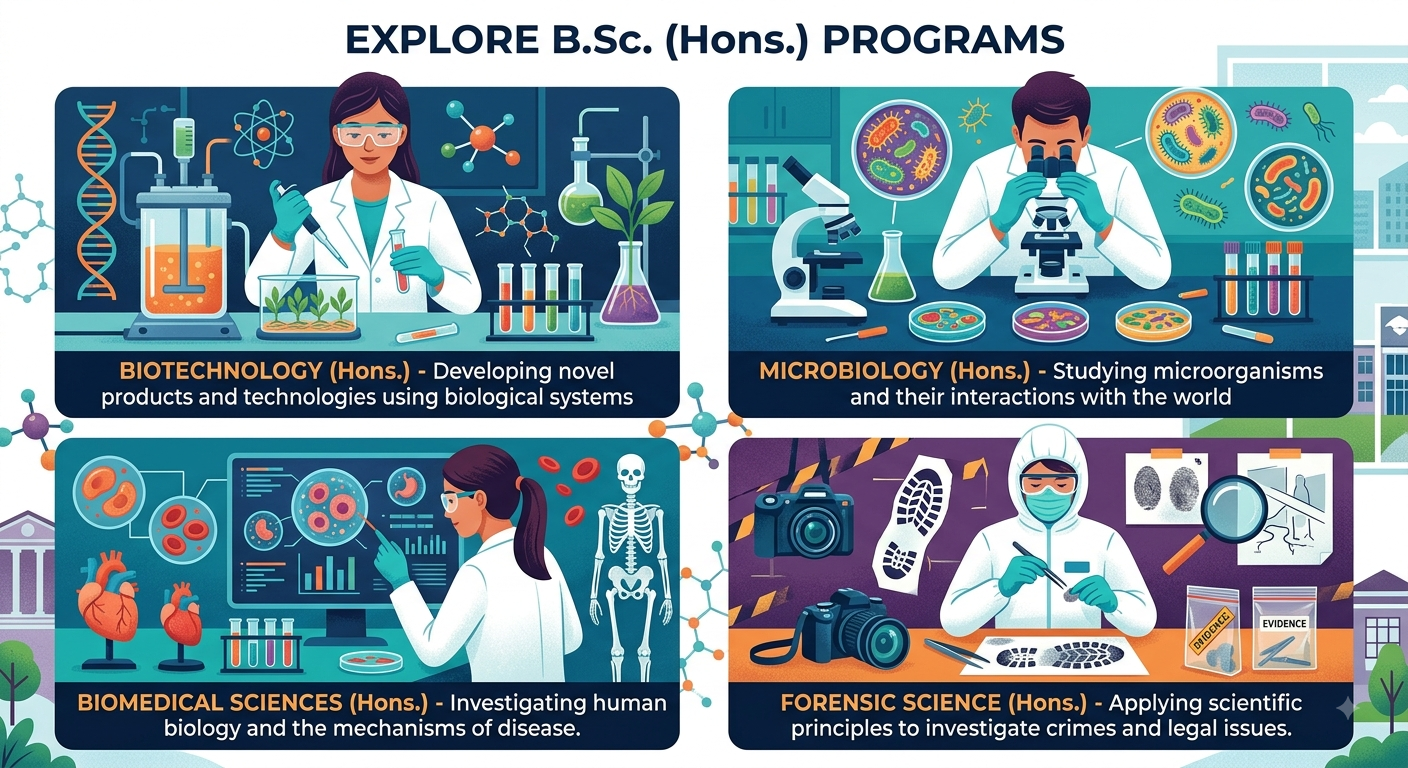
1. B.Sc. (Hons.) Biotechnology: Turning Biology into Innovation
Biotechnology is one of the most versatile branches of modern life science. It combines biology with technology to develop applications in healthcare, agriculture, pharmaceuticals, environmental science and industrial production.
The B.Sc. (Hons.) Biotechnology at IAR is a four-year, eight-semester program carrying 176 credits. The curriculum begins with fundamental subjects such as biochemistry, microbiology, molecular and cell biology, chemistry, plant physiology and mammalian physiology. As students progress, they encounter more advanced areas such as recombinant DNA technology, genomics and proteomics, bioinformatics, immunology, industrial microbiology, nanotechnology and animal and plant biotechnology.
What makes Biotechnology at IAR interesting?
The program is not limited to classroom theory. Students get opportunities for practical laboratory learning, workshops, public lectures, industrial visits and conferences. The university also highlights opportunities for internships and research exposure.
This makes the program particularly suitable for students who are interested in:
- Molecular biology and genetic engineering
- Pharmaceutical and biotechnology industries
- Research and development
- Bioinformatics and genomics
- Industrial biotechnology
- Higher studies such as M.Sc. and Ph.D.
Graduates can explore opportunities in biotechnology companies, pharmaceutical organizations, research laboratories, quality-control functions and government scientific organizations, while also pursuing postgraduate education.
Why IAR?
For aspiring biotechnologists, IAR offers the advantage of studying within a university environment that has a dedicated School of Biotechnology and Bioengineering, postgraduate programs and Ph.D. opportunities in related areas. This creates an ecosystem where undergraduate learning can be connected with advanced research and higher studies.
2. B.Sc. (Hons.) Microbiology: Understanding the Invisible World
Microorganisms may be invisible to the naked eye, but their impact on human health, food, agriculture, pharmaceuticals and the environment is enormous.
The B.Sc. (Hons.) Microbiology at IAR is a four-year undergraduate program designed to develop students’ ability to identify, handle and analyze microorganisms using microbiological techniques. The curriculum covers areas including bacteriology, virology, mycology, microbial physiology and metabolism, molecular biology, immunology, food and dairy microbiology, and industrial microbiology.
Students also study interdisciplinary subjects such as biosafety and bioethics, bioentrepreneurship and intellectual property rights, developmental biology and bioinformatics.
From laboratory learning to real-world applications
Microbiology is highly practical, which is why hands-on experience is especially important. IAR’s program combines theoretical instruction with laboratory work and includes a mandatory internship in research institutes, healthcare settings or industry. In the final year, students can undertake a dissertation project or on-the-job training.
This can prepare students for career areas such as:
- Clinical and diagnostic laboratories
- Pharmaceutical companies
- Food and beverage industries
- Hospitals and healthcare
- Agricultural and environmental organizations
- Research laboratories
- Industrial microbiology
Students can also pursue M.Sc. programs in microbiology, biotechnology or related life-science disciplines, followed by research-oriented higher education.
Why IAR?
IAR provides a strong combination of microbiology fundamentals, laboratory exposure, internships and research opportunities. The presence of related programs such as B.Sc. Biotechnology, M.Sc. Microbiology, M.Sc. Biotechnology and Ph.D. programs within the same School of Biotechnology and Bioengineering can also support students who want to continue their academic journey.
3. B.Sc. (Hons.) Biomedical Sciences: Connecting Biology with Healthcare
If your interests lie at the intersection of biology, medicine, disease, diagnostics and healthcare research, Biomedical Sciences can be an excellent option.
IAR’s B.Sc. (Hons.) Biomedical Sciences is a four-year program designed according to NEP 2020 and UGC guidelines. It combines core scientific education with multidisciplinary and skill-enhancement courses.
The curriculum includes subjects such as:
- Human Anatomy and Physiology
- Pharmacology
- Toxicology
- Cancer Biology
- Clinical Biochemistry
- Genetics
- Immunology
- Medical Microbiology
- Tissue Engineering
- Pathological Basis of Diseases
- Bioinformatics
- Computer-Aided Drug Design
- Tools and Model Organisms in Biomedical Research
This broad curriculum allows students to understand how biological processes relate to diseases, diagnosis, drug discovery and healthcare innovation.
Research and healthcare-oriented learning
The program includes practical laboratory components and opportunities for students to undertake dissertation research with faculty mentors or internships/on-the-job training with scientists and healthcare professionals during the later semesters. I
Career and higher-study possibilities can include:
- Biomedical research
- Pharmaceutical companies
- Diagnostic laboratories
- Healthcare organizations
- Research institutions
- Academic research
- Medical coding and related healthcare roles
- Higher studies in biomedicine, biotechnology and life sciences
Why IAR?
Biomedical Sciences benefits from being taught within an institution that has expertise spanning biotechnology, microbiology and other biological sciences. At IAR, students can gain exposure to laboratory-based learning, research projects and internships while developing a foundation for further study or careers related to biomedical research and healthcare.
4. B.Sc. (Hons.) Forensic Science: Where Science Meets Investigation
For students fascinated by crime investigation, evidence analysis and the application of science to the justice system, Forensic Science offers a distinctive career path.
Forensic science applies scientific principles to evidence that may be associated with criminal investigations. It can involve biological evidence, toxicology, analytical techniques and other scientific approaches used to help investigate cases.
IAR offers B.Sc. (Hons.) Forensic Science as part of its School of Biotechnology and Bioengineering. The program is included among IAR’s four-year B.Sc. (Hons.) science programs and is designed to provide students with a foundation for scientific and forensic career pathways.
Why choose Forensic Science?
The discipline can be suitable for students who enjoy:
- Biology and chemistry
- Evidence analysis
- Laboratory investigation
- Problem-solving
- Scientific research
- Criminal investigation
- Applying science to real-world cases
Students can explore further education in forensic science and related disciplines, while career possibilities may extend into forensic laboratories, scientific organizations, investigation-related services and research.
IAR also offers an M.Sc. in Forensic Science, creating a pathway for students who want to continue their education after completing their undergraduate degree. Its postgraduate forensic program emphasizes laboratory training, scientific analysis, case studies, crime-scene simulations and research-driven projects.
Forensic Science students benefit from being part of a broader biological-science ecosystem. The combination of undergraduate forensic education with related programs in biotechnology, microbiology and biomedical sciences—and the availability of postgraduate forensic study—can support interdisciplinary learning and continued academic development.
Why IAR?
IAR is the best place for career-oriented education. Whether Faculty always encourages students to try new things. Good infrastructure. Peaceful environment