Last updated: 23 November 2026
Quick answer: B.Sc (Hons) Agriculture is a four-year degree open to Class 12 students with at least three of Physics, Chemistry, Maths, Biology and Agriculture. It leads to jobs in banks, state agriculture departments, agri-business, seed and fertiliser companies, food processing and research, plus options like M.Sc, MBA in agribusiness and your own agri venture.
Key highlights
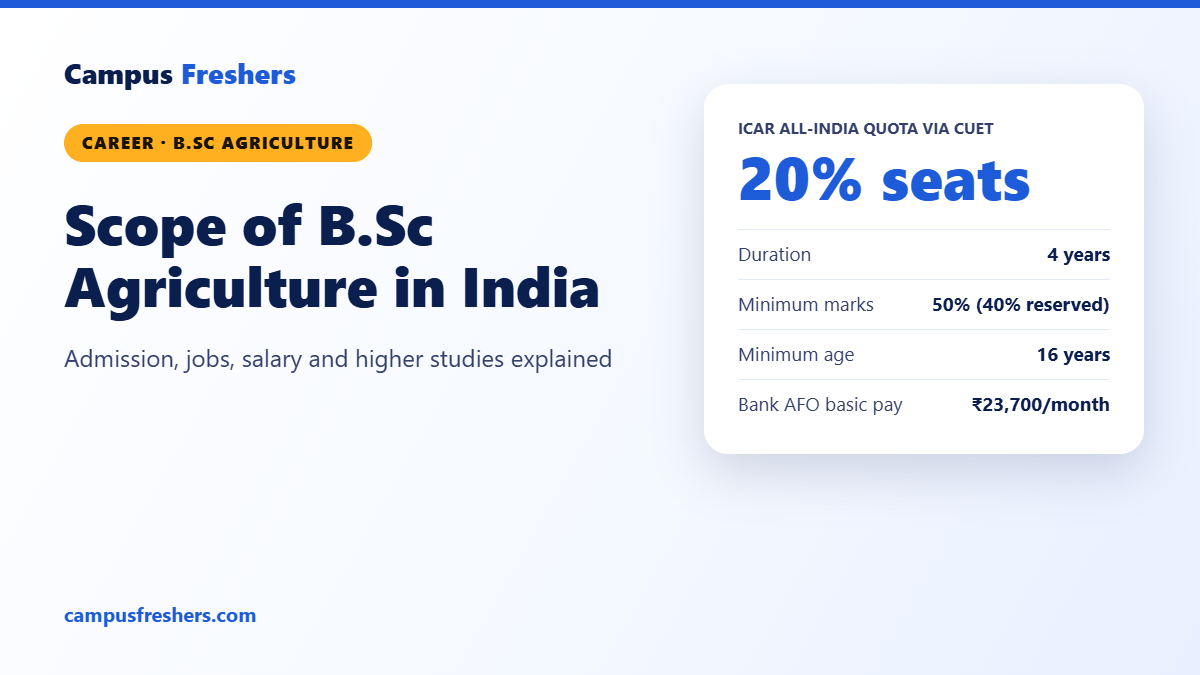
- Duration: 4 years, B.Sc (Hons) Agriculture
- Eligibility (ICAR quota): Class 12 with at least three of Physics, Chemistry, Maths, Biology and Agriculture; 50% aggregate (40% for SC, ST, Third Gender and PwBD)
- Entrance route: CUET (UG) for ICAR’s 20% all-India quota in agricultural universities, plus state-level exams and counselling for state seats
- Minimum age: 16 years (as on 31 August for the ICAR 2026 cycle)
- Government job example: IBPS Agricultural Field Officer (Scale I) needs a 4-year agriculture or allied degree; reported basic pay ₹23,700 a month
What is B.Sc Agriculture?
B.Sc Agriculture, now usually called B.Sc (Hons) Agriculture, is a science degree about how we grow food and manage farms. You study soil science, agronomy (crop production), plant breeding and genetics, plant pathology, entomology (insects and pests), horticulture, agricultural economics, extension education and farm machinery. A large part of the course is practical: field work, lab work and a rural agricultural work experience in the final year in most universities.
It is one of 13 four-year undergraduate programmes that ICAR (Indian Council of Agricultural Research) lists for admission through its all-India quota. Others include Horticulture, Forestry, Fisheries Science, Agribusiness Management, Natural Farming, and B.Tech courses in Agricultural Engineering, Dairy Technology, Food Technology and Biotechnology.
Who is eligible for B.Sc Agriculture?
For the ICAR all-India quota, the CUET (ICAR-UG) 2026 information bulletin sets these basic rules. Individual universities can add their own conditions, such as an upper age limit or a specific subject group, so always read the rules of the university you are aiming for.
| Criteria | Requirement (ICAR quota) |
|---|---|
| Class 12 subjects | At least three from Physics, Chemistry, Mathematics, Biology and Agriculture/Inter-Agriculture |
| Minimum marks | 50% aggregate for General, OBC (NCL), EWS and UPS; 40% for SC, ST, Third Gender and PwBD |
| Rounding | Not allowed (49.99% is not treated as 50%) |
| Minimum age | 16 years as on 31 August of the admission year (2026 cycle) |
| Entrance exam | CUET (UG), conducted by NTA |
Good news for students who took Agriculture in Class 12: in October 2025, the Union Agriculture Ministry said eligibility and subject groups for the ICAR quota were being made uniform, so that most ICAR quota seats in B.Sc Agriculture are open to students from an Agriculture stream too.
How do you get admission?
There are two main routes, and you can try both in the same year.
- ICAR all-India quota (20% of seats): Agricultural universities fill 20% of their undergraduate seats through ICAR’s counselling, based on CUET (UG) scores. Some central institutions fill all their seats this way. Counselling happens on icarcounseling.com after the CUET results.
- State quota (most seats): The remaining seats in state agricultural universities are filled by each state through its own entrance test or merit list (for example, state CETs). Check your state agricultural university’s website for dates.
- Private universities: Many private universities run B.Sc Agriculture with their own tests or merit-based admission. Check that the programme follows the recognised four-year structure before you pay fees.
For the 2025-26 session, the ICAR bulletin lists 6,002 seats across its 13 programmes under the all-India quota. Seat numbers for each new year are published in ICAR’s counselling brochure.
What jobs can you get after B.Sc Agriculture?
This is a degree with real demand in both government and private sectors, because agriculture touches banking, insurance, food, chemicals and technology.
| Sector | Common roles | Where you work |
|---|---|---|
| Banking | Agricultural Field Officer, rural development officer | Public sector banks (through IBPS SO), regional rural banks, NABARD-linked roles |
| Government | Agriculture officer, agriculture development officer, horticulture officer, extension officer | State agriculture departments, Krishi Vigyan Kendras, state PSC posts |
| Agri inputs | Sales officer, field development officer, product executive | Seed, fertiliser, pesticide and farm machinery companies |
| Food and agri-business | Quality executive, procurement officer, supply chain associate | Food processing firms, warehousing, agri-commodity companies |
| Research and teaching | Junior research fellow, scientist (after higher studies) | ICAR institutes, agricultural universities |
| Agri-tech and startups | Field operations, farmer outreach, data and advisory roles | Agri-tech startups, farmer producer organisations, your own venture |
How much can you earn?
Pay depends on the employer, your role and your location. Here is one clear government benchmark: for IBPS Specialist Officer posts at Scale I, which include Agricultural Field Officer, Careers360 reports a basic pay of ₹23,700 a month, with allowances like DA and HRA added on top. State government agriculture officer posts follow the pay levels of each state.
In the private sector, starting pay for fresh graduates in sales and field roles varies widely between companies and regions, and grows quickly with experience and results. Specialisation through an M.Sc or an MBA in agribusiness usually opens better-paying roles in management, research and analytics.
Higher studies after B.Sc Agriculture
- M.Sc in Agriculture (Agronomy, Soil Science, Plant Breeding, Entomology, Agricultural Economics and more), through ICAR’s PG entrance
- MBA in Agribusiness Management for roles in marketing, supply chain and rural finance
- Ph.D for careers in research and teaching at universities and ICAR institutes
- Civil services and state PSC exams, where agriculture is also an optional subject in some exams
Is B.Sc Agriculture right for you?
It suits you if you like biology and the outdoors, are curious about how food reaches your plate, and do not mind field work in the sun and mud. It is a good choice if you want a steady government job track (banks, state departments) or want to build something in agri-business. It may not suit you if you want a purely desk-based or city-only job from day one, since early roles often involve travel to villages and farms.
- Check your Class 12 subjects against the eligibility table above.
- Register for CUET (UG) when NTA opens the form, and choose the subjects your target universities ask for.
- Note your state agricultural university’s entrance exam dates as well.
- After results, register on icarcounseling.com for the ICAR quota and on your state portal for state seats.
FAQs
Can a PCM student do B.Sc Agriculture?
Under ICAR rules you need any three of Physics, Chemistry, Maths, Biology and Agriculture, so PCM can qualify for the ICAR quota. Some universities still ask for Biology, so check each university’s conditions.
Is NEET required for B.Sc Agriculture?
No. ICAR quota admission is through CUET (UG). State seats are filled through state entrance tests or merit lists, depending on the state.
How long is the B.Sc Agriculture course?
It is a four-year degree. The final year usually includes a rural work experience and practical training.
Is B.Sc Agriculture good for government jobs?
Yes. Graduates can apply for posts like IBPS Agricultural Field Officer, state agriculture officer posts and other roles that ask for a four-year agriculture degree.
What is the difference between B.Sc Agriculture and B.Sc Horticulture?
B.Sc Agriculture covers field crops, soil, pests and farm management broadly. B.Sc Horticulture focuses on fruits, vegetables, flowers, spices and plantation crops.
Can I do an MBA after B.Sc Agriculture?
Yes. An MBA in Agribusiness Management is a popular path, and a general MBA through CAT or other exams is also possible.
Official links and sources
- ICAR: CUET (ICAR-UG) 2026 Information Bulletin
- ICAR: Public notice on UG counselling 2026
- PIB: 20% of agricultural university seats through ICAR’s all-India test (3 October 2025)
- IBPS SO: Essential qualification post-wise (SATHEE, IIT Kanpur)
- Careers360: IBPS SO salary structure