Last updated: 18 November 2026
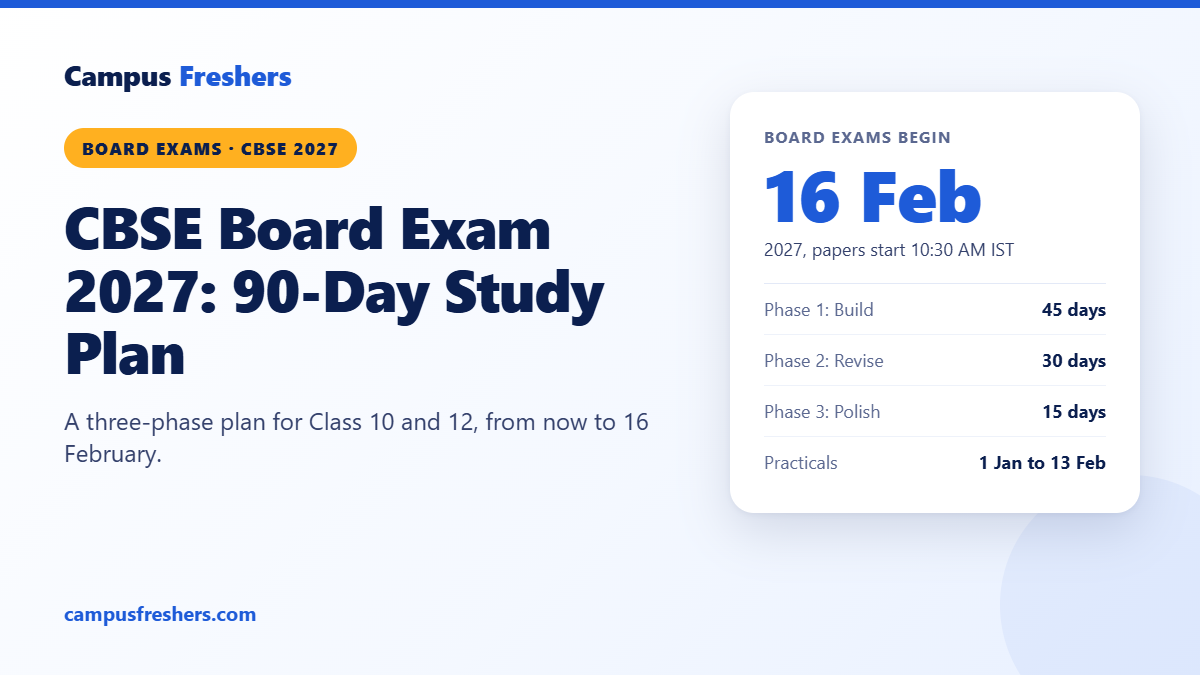
Quick answer: CBSE Class 10 and 12 board exams 2027 begin on 16 February, which leaves about 90 days from mid-November. A good plan splits this into three blocks: finish and strengthen the syllabus in the first 45 days, revise and practise papers in the next 30, and spend the last 15 days on sample papers, weak areas and rest.
Key highlights
- Board exams begin: 16 February 2027 for both Class 10 and Class 12, at 10:30 AM IST
- Last paper: 9 March 2027 for Class 10 and 9 April 2027 for Class 12
- Practicals and internal assessment: 1 January to 13 February 2027 for most schools
- Students expected: over 26.5 lakh in Class 10 and over 19.8 lakh in Class 12
- The plan below: 45 days to build, 30 days to revise, 15 days to polish
How many days are left for CBSE board exams 2027?
From 18 November 2026, there are about 90 days to the first paper on 16 February 2027. That sounds like a lot, but practicals, pre-boards and school tests will take up part of January and early February. So treat the real study window as closer to 75 to 80 days and plan accordingly.
CBSE 2027: key exam dates to plan around
| Class | Subject | Date |
|---|---|---|
| Class 10 | Mathematics (Standard / Basic) | 17 February 2027 |
| Class 10 | Science | 22 February 2027 |
| Class 10 | English | 26 February 2027 |
| Class 10 | Social Science | 8 March 2027 |
| Class 12 | Physics | 16 February 2027 |
| Class 12 | Accountancy | 23 February 2027 |
| Class 12 | Chemistry | 27 February 2027 |
| Class 12 | Mathematics / Applied Mathematics | 9 March 2027 |
| Class 12 | Biology | 25 March 2027 |
Check the official CBSE date sheet for your exact subject codes before you finalise your plan.
Phase 1 (Days 1 to 45): How to finish and strengthen the syllabus
This phase runs roughly from mid-November to the end of December.
- Finish pending chapters first. If your school has not completed the syllabus, study those chapters from NCERT on your own instead of waiting.
- Make one-page notes per chapter. Write formulas, key definitions, dates and diagrams on a single page. These will be your revision sheets later.
- Solve NCERT exercises fully. For Maths and Science, NCERT questions and examples are the base of most board papers.
- Use a simple daily routine: two subjects a day, one “heavy” (Maths, Physics, Accountancy) and one “light” (English, a language or a theory subject).
- Plan around practicals. Complete your practical files and project work by the end of December, since practicals start from 1 January for most schools.
Phase 2 (Days 46 to 75): How to revise and practise papers
This phase covers January and the first days of February.
- Revise from your own notes, not from the full textbook every time.
- Solve CBSE sample papers and previous year papers in a timed, three-hour sitting at least twice a week.
- Check your answers honestly. Mark where you lost marks: concept gaps, silly mistakes, poor presentation or running out of time.
- Keep a mistakes notebook. Write down every error and the correct method. Revise this notebook every Sunday.
- Do not skip practicals and pre-boards. Internal marks count, and pre-boards show you where you stand.
Phase 3 (Days 76 to 90): How to polish in the final 15 days
- Focus on weak chapters, but do not start anything completely new.
- Revise formulas, diagrams and maps daily in short sessions.
- Practise writing answers neatly: underline key points, draw labelled diagrams and follow the word limit.
- Sleep 7 to 8 hours. A tired mind makes more mistakes than an under-revised one.
- Use the gaps between papers wisely. For Class 12 especially, the gaps are uneven, so plan revision for each paper based on the days available.
A sample daily timetable for school days
| Time | What to do |
|---|---|
| Before school (45 minutes) | Revise formulas or one-page notes |
| After school (2 hours) | Main subject: new chapter or practice questions |
| Evening (1.5 hours) | Second subject: theory or language |
| Night (30 minutes) | Mistakes notebook and quick recap |
| Weekends | One full timed paper, plus checking and correction |
Adjust this to your school timings and coaching schedule. The idea is steady daily study, not long weekend marathons.
Which mistakes should students avoid?
- Collecting too many books. NCERT, your notes and sample papers are enough for most students.
- Only reading, not writing. Board exams test writing speed and presentation, so practise writing full answers.
- Ignoring languages and “easy” subjects. They can lift your overall percentage a lot.
- Comparing with friends. Follow your own plan and track your own progress.
- Studying late into the night before a paper. Rest matters more at that stage.
What should students do next?
- Download the official date sheet from cbse.gov.in and stick it near your study table.
- Count the chapters left in each subject and divide them across the next 45 days.
- Collect the latest CBSE sample papers for all your subjects.
- Fix one weekly slot for a full timed paper and start this weekend.
- Talk to your teachers early about any chapter you find hard, before pre-boards begin.
FAQs
When do CBSE board exams 2027 start?
CBSE Class 10 and Class 12 board exams start on 16 February 2027. All papers begin at 10:30 AM IST.
Is 90 days enough to prepare for CBSE board exams?
Yes, if you study regularly. Most students have already covered a large part of the syllabus in school, so these 90 days are best used to finish gaps, revise and practise full papers.
How many sample papers should I solve?
Aim to solve the official CBSE sample paper for each subject plus at least four to five previous year papers in timed conditions. Checking and learning from your mistakes matters more than the number of papers.
How many hours should I study daily for board exams?
On school days, around 3 to 4 focused hours is a realistic target, and 6 to 7 hours on holidays. Consistency every day works better than very long sessions now and then.
When are CBSE practical exams for 2027?
For most schools in India and abroad, practicals and internal assessments run from 1 January to 13 February 2027. Winter-bound schools hold them earlier, from 9 November to 19 December 2026.
Should I focus on NCERT or reference books?
Start with NCERT, since board papers are based on it. Use reference books only for extra practice once you are comfortable with NCERT questions.
Sources
- CBSE official website
- CBSE Date Sheet 2027 (official PDF)
- All India Radio News: CBSE releases 2027 board exam date sheet