Last updated: 25 November 2026
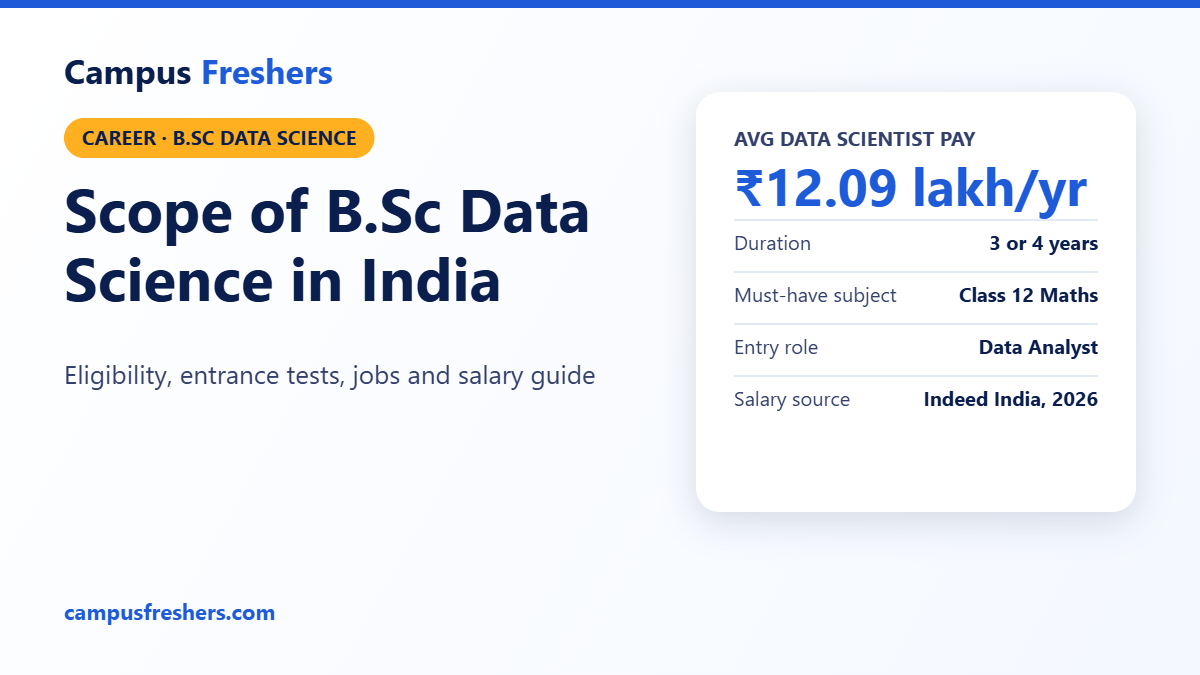
Quick answer: B.Sc Data Science is a 3 or 4 year degree that mixes statistics, mathematics and programming. You need Class 12 with Mathematics, usually with 45% to 50% marks. Graduates work as data analysts, business intelligence analysts and, with more skills, data scientists. Demand for AI and data talent in India is growing fast.
Key highlights
- Duration: 3 years, or 4 years with Honours under the NEP structure at many universities
- Eligibility: Class 12 with Mathematics; typical minimum 45% to 50% depending on the college
- Admission: college entrance tests such as SET (Symbiosis), XET (St. Xavier’s Mumbai), NMIMS-MST, or CUET at some universities
- Fees at well-known private colleges: roughly ₹1.25 lakh to ₹2 lakh per year (examples below)
- Average data scientist salary in India: ₹12,09,022 per year, as per Indeed India (August 2026)
- Nasscom and Deloitte project India’s AI talent demand to cross 12.5 lakh by 2027
What is B.Sc Data Science?
Data science is about collecting data, cleaning it, finding patterns in it and using those patterns to make decisions. A B.Sc in Data Science teaches you the three building blocks for this: statistics, mathematics and computer programming. Later semesters add machine learning, artificial intelligence and real projects with company data.
It is different from B.Tech in Computer Science. A B.Sc programme is lighter on engineering subjects like electronics and hardware, and heavier on statistics and analysis. That makes it a good fit for students who enjoy maths and numbers but do not want a full engineering degree.
Who is eligible for B.Sc Data Science?
Almost every college asks for Class 12 with Mathematics. Some also accept Statistics. The stream does not always matter, so commerce students with Maths can often apply. Here is what a few well-known colleges ask for, based on their official admission pages.
| College | Eligibility | Duration | Fees (as published) |
|---|---|---|---|
| CHRIST (Deemed to be University), Bengaluru: B.Sc Data Science, Statistics | Pass Class 12 with Mathematics | 3 years, optional 4th year for Honours | ₹1,25,000 per year (Karnataka), ₹1,45,000 per year (other states) |
| NMIMS Nilkamal School of Mathematics, Mumbai: B.Sc (Data Science) | Class 12, any stream, 50% with Maths and/or Statistics | 4 years, exit option after year 3 | ₹2,00,000 per year (2025-26 reference) |
| St. Xavier’s College, Mumbai: B.Sc Data Science and AI | Class 12 with Mathematics, at least 45% aggregate | As per college notice | To be published on the college website |
| Symbiosis Statistical Institute, Pune: B.Sc Applied Statistics and Data Science | Class 12 with 50% (45% for SC/ST) and Maths or Statistics | 4 years | Check the official SET website |
Fees and rules change every year, so always read the latest admission notice of the college before applying.
How do you get admission?
There is no single national entrance test for B.Sc Data Science. Most good colleges run their own test or use an existing one:
- SET: the Symbiosis Entrance Test, used by Symbiosis Statistical Institute, Pune, followed by a personal interview.
- XET: St. Xavier’s Mumbai’s entrance test. In 2026 it was a 75-mark, 1.5-hour paper with no negative marking, mostly Maths. Final merit was 60% test score and 40% Class 12 marks.
- NMIMS-MST: a 120-mark, 100-minute test with Quantitative, Logical and Verbal sections. NMIMS also accepts MHT-CET or JEE Main scores.
- CHRIST: online application, then an entrance test where applicable, assessment and interview.
- CUET UG: some universities, for example Delhi Technological University for its new integrated BSc-MSc programme in data science, admit through CUET scores.
If you are aiming for an IIT brand, the IIT Madras BS in Data Science and Applications is open to anyone who has passed Class 12, irrespective of age or stream, through a qualifier exam. We have a separate guide on it below.
What will you study?
The syllabus moves from basics to advanced tools. CHRIST University’s published course plan is a good example of a typical structure:
| Stage | Main subjects |
|---|---|
| Year 1 | Programming foundations, descriptive statistics, calculus, data structures, probability distributions, discrete mathematics |
| Year 2 | Database management, artificial intelligence, estimation theory, machine learning, hypothesis testing, linear algebra |
| Year 3 | Neural networks and deep learning, time series forecasting, applied statistics, research project, internship |
| Year 4 (Honours) | Multivariate analysis, Bayesian techniques, simulation, research methodology, dissertation |
Alongside the degree, try to pick up practical tools that employers ask for, such as Python, SQL, Excel and a dashboard tool like Power BI or Tableau. Projects on GitHub or Kaggle make your CV much stronger.
What jobs can you get after B.Sc Data Science?
College placement pages list roles such as Data Analyst, Business Intelligence Analyst, Statistical Analyst, Machine Learning Analyst, Market Research Analyst, Financial Data Analyst, Risk Analyst and Research Associate. With experience, or a master’s degree, many move into Data Scientist and Machine Learning Engineer roles.
Employers include IT and consulting firms, banks and fintech companies, e-commerce, healthcare and pharma companies, market research agencies and government data projects.
How much can you earn?
Salary depends heavily on your skills, projects, city and employer, not just your degree. Here is what public salary data shows:
| Role and experience | Reported salary | Source |
|---|---|---|
| Data Analyst, fresher | ₹1.2 lakh to ₹14 lakh per year (very wide range) | AmbitionBox data cited by Careers360 |
| Data Analyst, 3 years | ₹2.4 lakh to ₹14.2 lakh per year | AmbitionBox data cited by Careers360 |
| Data Analyst, 5 years | ₹2.9 lakh to ₹23 lakh per year | AmbitionBox data cited by Careers360 |
| Data Scientist, average | ₹12,09,022 per year | Indeed India, August 2026 |
Treat these as rough guides. Most freshers start at the lower end of these ranges, and the top figures usually go to candidates with strong skills, internships and portfolios.
Is there real demand for data science skills?
Yes. A Deloitte and Nasscom report projected that India’s AI talent demand will grow from about 6 to 6.5 lakh people to more than 12.5 lakh between 2022 and 2027. A 2026 Nasscom and Indeed study found that 63% of employers had seen a year-on-year increase in hiring for AI-related roles, and 40% preferred proven AI skills or certifications over degrees alone. The message for students is clear: the degree opens the door, but skills decide the job.
What can you study after B.Sc Data Science?
- M.Sc Data Science, Statistics or Big Data Analytics: for example, St. Xavier’s Mumbai offers a 2-year M.Sc Big Data Analytics that accepts B.Sc Data Science graduates.
- MBA in Business Analytics: good if you want to move towards management roles.
- Master’s abroad: data science and analytics are popular choices for Indian students in the US, UK, Germany and Canada.
- Certifications: cloud, machine learning and analytics certificates help you specialise quickly.
Is B.Sc Data Science right for you?
It is a good choice if you enjoy maths and logic, like solving puzzles with numbers, and are ready to keep learning new tools every year. It may not suit you if you dislike statistics or coding. Before you decide, try a free online Python or statistics course for a few weeks. If you enjoy it, this degree is worth a serious look.
Frequently asked questions
Is Maths compulsory for B.Sc Data Science?
Yes, at almost every college. Most ask for Mathematics in Class 12, and a few also accept Statistics. Check the exact rule in the college’s admission notice.
Can commerce students do B.Sc Data Science?
Yes, if they studied Mathematics in Class 12. Colleges like NMIMS accept Class 12 from any stream as long as Maths or Statistics was a subject.
Is B.Sc Data Science better than BCA?
Neither is better for everyone. B.Sc Data Science focuses more on statistics and analysis, while BCA focuses more on software development. Pick based on whether you prefer analysing data or building applications.
Is the degree 3 years or 4 years?
Both exist. Under NEP, many universities offer a 3-year degree with an optional fourth year for Honours or Honours with Research, while some, like NMIMS and Symbiosis, run 4-year programmes.
What is the salary of a data scientist in India?
Indeed India reported an average of ₹12,09,022 per year for data scientists in August 2026. Freshers usually start as data analysts at lower salaries and grow with experience.
Do I need a master’s degree to become a data scientist?
Not always. Many graduates start as analysts and move up with experience and strong projects. A master’s degree can speed this up and help for research or senior roles.
Official links and sources
- CHRIST University: B.Sc Data Science, Statistics programme page
- NMIMS B.Sc programmes admission handout 2026 (PDF)
- St. Xavier’s Mumbai B.Sc DSAI admission notice 2026 (PDF)
- Symbiosis Statistical Institute, Pune (SET)
- IIT Madras BS Data Science admissions
- Indeed India: data scientist salaries
- Careers360: data analyst salary in India
- Deloitte and Nasscom AI skills report press release
- Nasscom and Indeed AI hiring report coverage