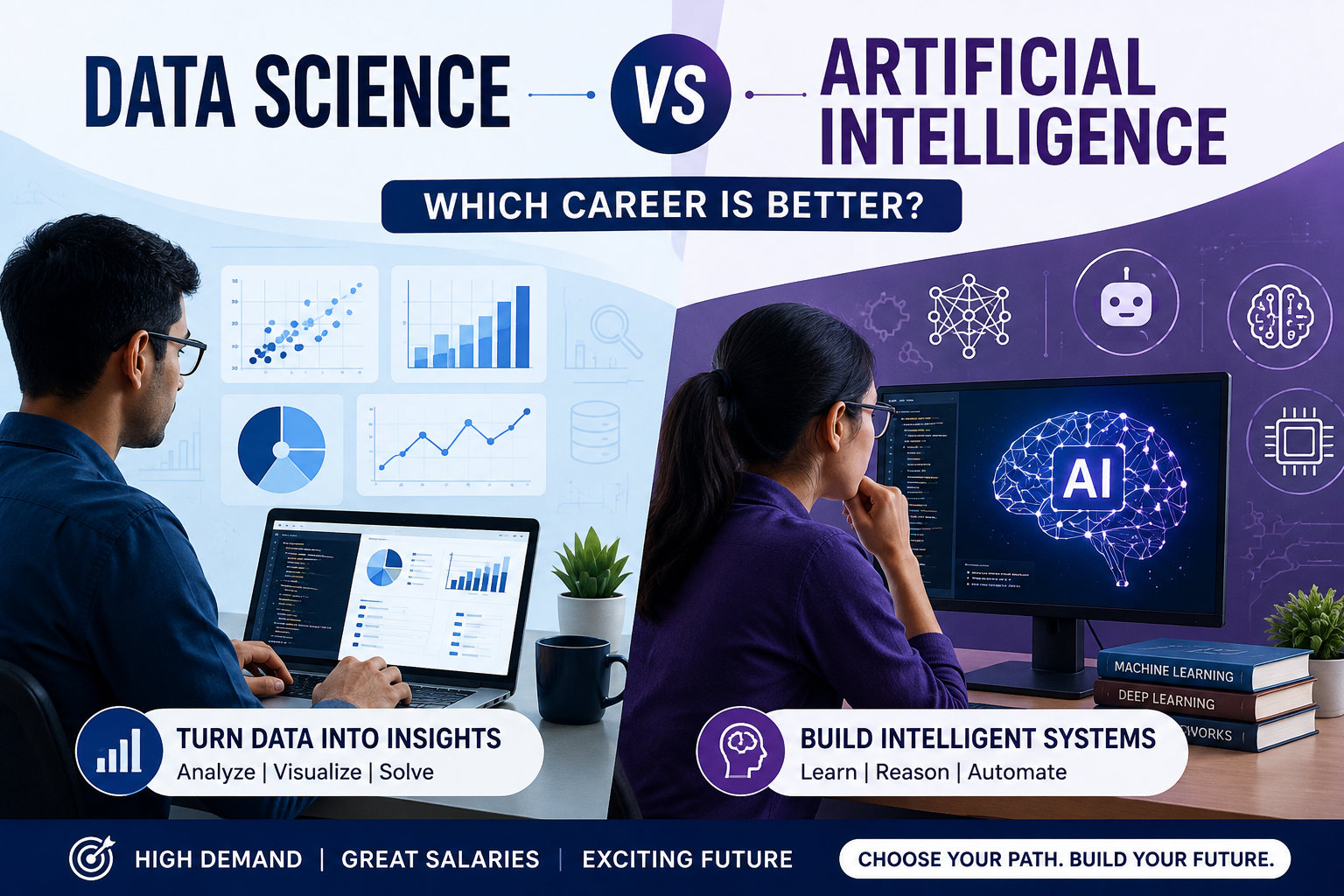
With Artificial Intelligence (AI) revolutionizing industries and Data Science driving data-powered decision-making, students often find themselves asking one important question: Data Science vs Artificial Intelligence—which career is better?
Both fields are among the fastest-growing and highest-paying career options in India and globally. However, they differ in terms of skills, job roles, salary, career opportunities, and future demand.
If you’re planning your career in technology, this guide compares Data Science vs Artificial Intelligence to help you choose the right path based on your interests and goals.
What is Data Science?
Data Science is the process of collecting, analyzing, and interpreting large volumes of data to help businesses make informed decisions.
A Data Scientist works with structured and unstructured data using statistics, programming, and machine learning techniques to uncover valuable insights.
Key Responsibilities
- Collect and clean data
- Analyze large datasets
- Build predictive models
- Create dashboards and reports
- Support business decision-making
To learn more about Data Science fundamentals and industry applications, visit IBM’s Data Science Guide.
What is Artificial Intelligence?
Artificial Intelligence (AI) is a branch of computer science focused on creating systems that can perform tasks that typically require human intelligence.
AI enables machines to learn, reason, recognize patterns, understand language, and make decisions with minimal human intervention.
Key Responsibilities
- Develop AI-powered applications
- Build machine learning models
- Design intelligent automation systems
- Create chatbots and virtual assistants
- Improve computer vision and speech recognition
Explore the latest AI technologies and innovations through Google AI.
Data Science vs Artificial Intelligence: Quick Comparison
| Feature | Data Science | Artificial Intelligence |
| Primary Focus | Data analysis and insights | Building intelligent systems |
| Main Objective | Solve business problems using data | Enable machines to think and learn |
| Core Skills | Statistics, Python, SQL | Python, Machine Learning, Deep Learning |
| Programming | Python, R, SQL | Python, Java, C++ |
| Mathematics | Statistics and Probability | Linear Algebra, Calculus, Probability |
| Industries | Finance, Healthcare, Marketing | Robotics, Healthcare, Automation, Finance |
| Career Growth | Excellent | Exceptional |
| Difficulty Level | Moderate | Advanced |
Skills Required
Skills for Data Science
- Python
- SQL
- Statistics
- Probability
- Excel
- Data Visualization
- Tableau
- Power BI
- Machine Learning Basics
Skills for Artificial Intelligence
- Python
- Machine Learning
- Deep Learning
- Neural Networks
- Computer Vision
- Natural Language Processing (NLP)
- TensorFlow
- PyTorch
- Mathematics
Educational Qualifications
Data Science
Most professionals come from backgrounds such as:
- B.Tech
- B.Sc. Computer Science
- Mathematics
- Statistics
- Economics
- MCA
- M.Sc.
Artificial Intelligence
Common educational backgrounds include:
- B.Tech Computer Science
- AI & ML Engineering
- Electronics Engineering
- Robotics
- MCA
- M.Tech AI
- Computer Engineering
Popular Job Roles
Data Science Careers
- Data Scientist
- Data Analyst
- Business Intelligence Analyst
- Data Engineer
- Analytics Consultant
- Machine Learning Analyst
Artificial Intelligence Careers
- AI Engineer
- Machine Learning Engineer
- NLP Engineer
- Computer Vision Engineer
- Robotics Engineer
- AI Research Scientist
Salary Comparison in India (Approximate)
| Experience | Data Science | Artificial Intelligence |
| Fresher | ₹6–10 LPA | ₹7–12 LPA |
| 2–5 Years | ₹10–18 LPA | ₹12–22 LPA |
| 5–10 Years | ₹18–35 LPA | ₹20–40+ LPA |
| Senior Level | ₹35–60+ LPA | ₹40–70+ LPA |
Salary varies based on company, location, skills, certifications, and experience.
Which Career Has Better Demand?
Both fields have excellent demand, but the opportunities differ slightly.
Data Science is widely used in:
- Banking
- E-commerce
- Healthcare
- Marketing
- Insurance
- Retail
- Consulting
Artificial Intelligence is growing rapidly in:
- Robotics
- Autonomous Vehicles
- Healthcare
- Cybersecurity
- Manufacturing
- Smart Cities
- FinTech
- Education Technology
Pros and Cons
Data Science
Pros
- High demand across industries
- Strong salary growth
- Easier entry compared to AI
- Business-focused career
Cons
- Heavy data cleaning work
- Requires statistical knowledge
- Continuous learning needed
Artificial Intelligence
Pros
- One of the highest-paying technology careers
- Future-focused industry
- Innovative and research-driven work
- Huge global demand
Cons
- Steeper learning curve
- Requires strong mathematics
- Constant technological changes
Which Should You Choose?
Choose Data Science If You:
- Enjoy analyzing data
- Like statistics and visualization
- Want to solve business problems
- Prefer working with dashboards and insights
Choose Artificial Intelligence If You:
- Love programming
- Enjoy solving complex technical problems
- Want to build intelligent applications
- Are interested in robotics, automation, or machine learning
Can You Learn Both?
Absolutely.
In fact, Data Science and Artificial Intelligence complement each other.
A strong understanding of Data Science provides a solid foundation for AI because machine learning models rely on high-quality data.
Many professionals begin with Data Science and later specialize in Artificial Intelligence or Machine Learning.
Best Courses to Start
Data Science
- B.Tech Computer Science
- B.Sc. Data Science
- MCA
- M.Sc. Data Science
- Online certifications in Python, SQL, Tableau, and Power BI
Artificial Intelligence
- B.Tech AI & Machine Learning
- B.Tech Computer Science
- M.Tech AI
- Machine Learning Specialization
- Deep Learning Certification
- TensorFlow Developer Certification
Future Scope
Both careers are expected to remain among the most in-demand technology professions over the next decade.
Data Science Future Scope
- Business Analytics
- Healthcare Analytics
- Financial Analytics
- Marketing Analytics
- Sports Analytics
Artificial Intelligence Future Scope
- Generative AI
- Robotics
- Autonomous Vehicles
- Smart Manufacturing
- AI Healthcare
- Cybersecurity
- Virtual Assistants
Wondering how AI is reshaping careers? Read our AI Will Replace These Jobs: What Students Should Study to explore future-proof careers and the skills students should develop.
Frequently Asked Questions
Which is better: Data Science or Artificial Intelligence?
Neither is universally better. Data Science is ideal for students interested in analytics and business insights, while Artificial Intelligence is better suited for those passionate about intelligent systems and automation.
Does AI require coding?
Yes. Programming, especially Python, is an essential skill for most AI roles.
Is Data Science easier than AI?
Generally, Data Science has a gentler learning curve, while AI often requires deeper knowledge of mathematics, algorithms, and machine learning.
Can I switch from Data Science to AI later?
Yes. Many professionals transition from Data Science into AI or Machine Learning after gaining experience.
Final Thoughts
When comparing Data Science vs Artificial Intelligence, there is no one-size-fits-all answer. Both fields offer excellent salaries, global career opportunities, and long-term growth.
If you enjoy analyzing data, solving business challenges, and working with insights, Data Science may be the right choice. If you’re excited by intelligent systems, machine learning, and cutting-edge innovation, Artificial Intelligence could be a better fit.
Whichever path you choose, focus on building strong programming skills, practical projects, and continuous learning to stay competitive in the evolving technology landscape.