There’s a quiet panic on Indian campuses right now, and you’ve probably felt it too. Group chats fill up with course links. A friend mentions they landed an internship “because they knew how to use AI tools.” Somewhere, a senior posts a screenshot of a job offer that didn’t exist three years ago. The message underneath all of it is the same: learn AI, or get left behind.
The pressure is real, but the panic isn’t necessary. The truth is that 2026 is one of the most forgiving moments in history to break into a high-value career — precisely because so few people have actually built the skills companies are scrambling for. India produces around 1.5 million engineering graduates a year, yet fewer than 3% have genuine, production-ready AI skills. That gap is your opportunity.
This guide cuts through the noise. No hype, no “AI will replace everyone” doom. Just a clear picture of which AI skills and AI-driven careers actually matter in 2026, what they pay, and exactly how you — student, fresher, or non-coder — can start building toward them this week.
Why AI Skills Suddenly Matter for Every Student
A few years ago, “AI” was a specialist corner of computer science reserved for PhDs and research labs. That world is gone. Today, artificial intelligence has become a mainstream professional requirement across nearly every industry in India — banking, healthcare, e-commerce, logistics, even marketing and design.
Three forces collided to make this happen:
The GenAI wave hit overnight. When tools like ChatGPT, Claude, and Gemini went mainstream, every major company — banks, hospitals, logistics firms, retailers — rushed to build AI teams. Most had no existing talent pipeline, so they started hiring aggressively and paying premiums.
Global Capability Centres (GCCs) expanded fast. International firms opened tech hubs in Bengaluru, Hyderabad, and Delhi NCR specifically to hire Indian AI talent. There are now over 450,000 AI-related job listings active across the country at any given time.
AI literacy became a baseline, not a bonus. According to NASSCOM, AI and data skills are now among the three fastest-growing requirements across both technical and management roles. The India Skills Report 2026 confirms AI, data analytics, cloud computing, and cybersecurity as the most in-demand skill clusters nationwide. India already commands roughly 16% of the global AI talent pool.
The takeaway for students is blunt: AI is no longer optional knowledge for “tech people.” It’s becoming the literacy of the decade — like email in the 2000s or smartphones in the 2010s. The students who treat it that way are the ones getting interviews.
The Most In-Demand AI Skills in 2026
Before chasing job titles, understand the building blocks. These are the AI skills employers are actively paying a premium for — and you can start learning most of them for free.
1. Python and Foundational Coding
Python remains the bedrock of AI development. It’s beginner-friendly, has the richest set of AI libraries (TensorFlow, PyTorch, scikit-learn, pandas), and is the language every AI tutorial assumes you know. If you learn only one technical skill, start here.
2. Prompt Engineering
This is the breakout skill of the decade for non-coders. Prompt engineering is the craft of getting precise, useful, reliable outputs from large language models. Demand for prompt engineers reportedly grew over 135% in a single year. The best part: you don’t need a CS degree to be good at it — you need clear thinking, strong language skills, and lots of practice.
3. Data Analysis and Data Literacy
Data is the fuel AI runs on. Knowing how to clean, interpret, and visualise data (with tools like Excel, SQL, Power BI, or Python) is a high-leverage skill on its own — and the natural on-ramp into machine learning. Data analysts who can also build basic ML models are now being hired at salaries that used to require a full data science title.
4. Machine Learning and Deep Learning
The deeper technical layer: understanding how models actually learn, training them, and tuning them. Deep learning shows up in roughly 28% of AI engineering job postings — the single most-requested machine learning competency. This is where serious specialisation (and serious pay) begins.
5. Generative AI and LLM Tooling
The hands-on stack behind ChatGPT-style products: working with large language models, fine-tuning, and retrieval-augmented generation (RAG). Recruiters in 2026 rank hands-on experience with generative AI models at the very top of their wish lists.
6. MLOps and Cloud Integration
The “make it actually work in the real world” skills — deploying models, integrating them with cloud platforms (AWS, Azure, Google Cloud), and keeping them running. If you have any backend or DevOps interest, this is one of the fastest paths to a well-paid AI-adjacent role.
7. AI Ethics and Responsible AI
As AI spreads into sensitive areas like hiring, lending, and healthcare, companies increasingly need people who understand fairness, bias, and responsible deployment. It’s an entry point especially suited to students from law, philosophy, social science, and humanities backgrounds.
The 43% premium: One analysis of over a billion job postings found that roles listing at least two AI skills paid around 43% more than comparable roles with none. Stacking even two of the skills above can meaningfully change your earning power.
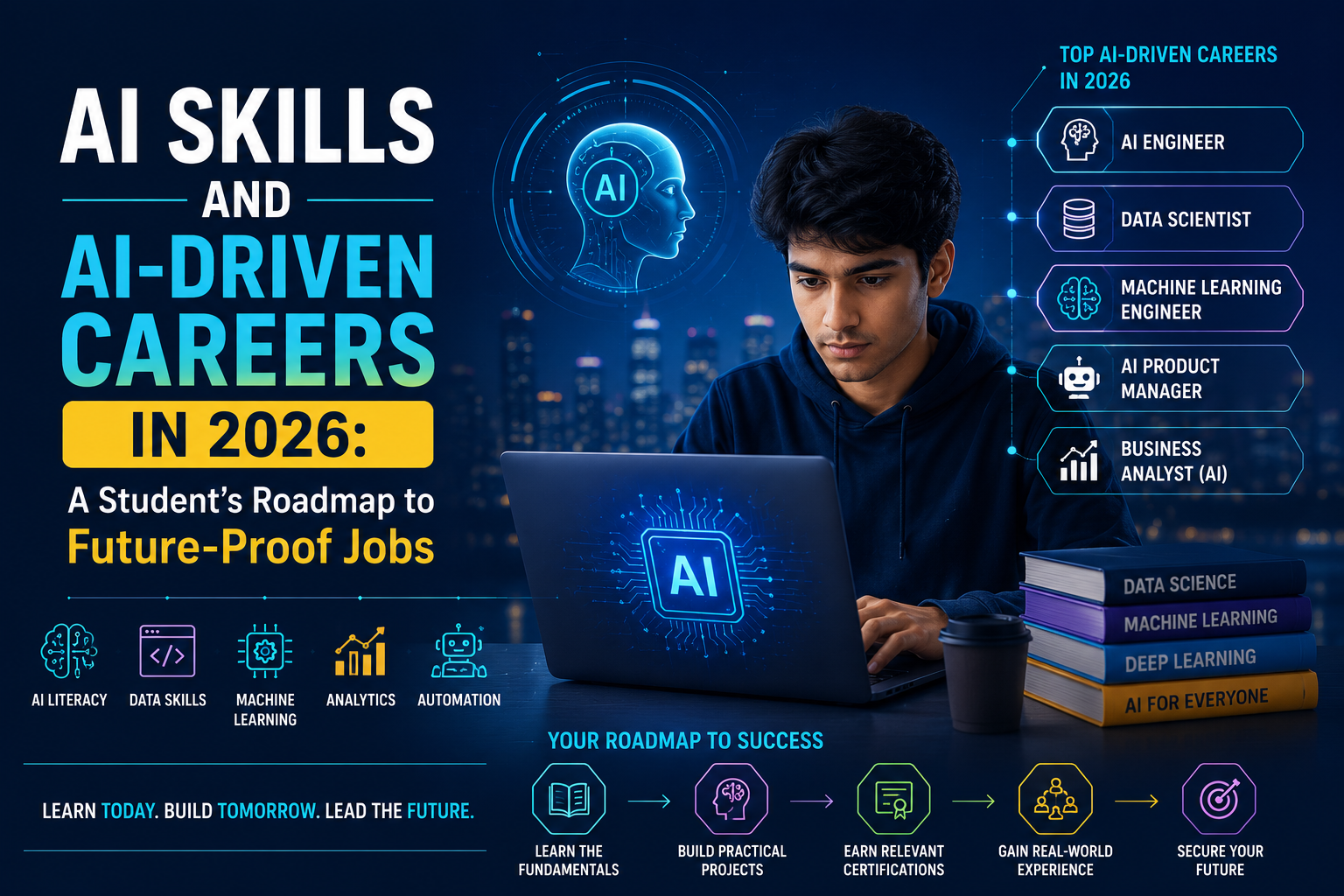
Top AI-Driven Careers for Students in 2026
Here’s where those skills lead. The roles below span the full range — from entry-level positions a fresher can target to specialist tracks worth building toward over a few years.
AI Engineer
Builds, trains, and deploys AI systems and models. A core technical role and one of the most common AI job titles. Typical range: ₹10–22 LPA, with entry-level roles starting around ₹6–8 LPA.
Machine Learning Engineer
Designs and ships ML models in collaboration with data scientists and software engineers. Typical range: ₹12–28 LPA, climbing to ₹30–50+ LPA with Agentic AI or MLOps expertise.
Data Scientist
Finds insights in data and builds predictive models that drive business decisions. The most established and accessible of the “serious AI” careers. Typical range: ₹8–20 LPA.
Generative AI Engineer
Builds applications on top of models like GPT, Claude, and diffusion models, wiring AI into real products and workflows. One of the most in-demand roles in the country thanks to a severe talent shortage. Freshers: ₹6–12 LPA; mid-level: ₹18–30 LPA; senior: ₹30–70 LPA.
NLP Engineer
Works on systems that understand and generate human language — chatbots, search, translation. Typical range: ₹12–25 LPA.
Prompt Engineer
Crafts and optimises the instructions that get the best results from AI systems. A rare role where strong language and reasoning skills can matter more than heavy coding — making it one of the friendliest entry points for non-CS students.
AI Research Scientist & AI Architect
The top of the ladder. Research scientists push model capabilities forward (₹18–40 LPA); AI architects design entire AI systems for organisations (₹28 LPA and above). These are goals to build toward, not starting points.
AI Ethics Specialist & AI-for-Business Consultant
Fast-emerging roles for people who can bridge AI and the real world — ensuring systems are fair, compliant, and genuinely useful. Ideal for non-technical professionals who pair domain knowledge with AI literacy.
A note on these numbers: salary ranges vary by city, company type, and your portfolio. Metro hubs like Bengaluru, Hyderabad, and Delhi NCR typically pay 15–20% more than the national average. Treat these as realistic 2026 benchmarks, not guarantees.
“But I’m Not a Coder” — Can Non-CS Students Still Get In?
Yes. Emphatically yes. This is the single biggest myth holding students back.
Recruiters in 2026 increasingly value domain expertise combined with AI skills over pure technical credentials. A commerce student who understands finance and can use AI tools is more valuable to a fintech company than a coder who knows neither. A design student who pairs creativity with generative AI is exactly who marketing teams are hunting for.
The most accessible on-ramps for non-CS students:
- Start with data analytics and basic Python — gentle, structured, and immediately useful.
- Master prompt engineering — pure skill, minimal coding, high demand.
- Target hybrid roles — AI Ethics Specialist, AI-for-Business Consultant, or AI-assisted content and design roles that reward your existing background.
Companies in 2026 consistently value projects over degrees. A strong portfolio beats a fancy certificate almost every time.
Your 5-Step AI Career Roadmap (Starting This Week)
You don’t need to enrol in an expensive bootcamp to begin. Here’s a practical sequence:
- Pick one core skill that matches your interest. Drawn to logic and numbers? Start with Python and data analysis. Strong with language and ideas? Start with prompt engineering. Don’t try to learn everything at once.
- Use free, world-class resources. Begin with free courses and tutorials before paying for anything. Reserve paid certifications for once you know the direction you want.
- Build real projects — immediately. Analyse a public dataset. Build a small chatbot. Create an AI-assisted portfolio piece. Recruiters want to see what you’ve made, not just what you’ve watched.
- Earn certifications strategically. Once you have a focus, credentials from IITs or global platforms like Microsoft, Google, and AWS carry real weight with recruiters and validate specialised skills.
- Start earning early. Freelancing on platforms like Internshala or Upwork — even small UI/UX, data, or AI-content gigs — builds your portfolio, your confidence, and your bank balance simultaneously. Project-based hiring is up significantly, and India’s gig workforce is projected to reach 23.5 million by 2030.
Frequently Asked Questions
Which AI skill should a complete beginner learn first? Start with either Python (if you enjoy logic and problem-solving) or prompt engineering (if your strength is language and clear thinking). Both have abundant free resources and lead naturally into deeper AI skills.
Do I need an engineering degree for an AI career in India? No. While many technical roles favour a CS or related background, non-CS students regularly enter through data analytics, prompt engineering, AI ethics, and AI-for-business roles. Domain expertise plus AI skills is genuinely valuable, and companies increasingly prioritise portfolios over degrees.
What’s the highest-paying entry point into AI? Generative AI roles currently top fresher pay, with strong-portfolio freshers earning ₹6–12 LPA. Machine Learning Engineering offers the steepest growth curve, climbing to ₹30–50+ LPA with experience in MLOps and Agentic AI.
Are AI jobs actually growing in India, or is it hype? The growth is real. There are over 450,000 active AI job listings, AI hiring rose about 25% in the past year, and India’s AI talent pool is projected to reach 1.25 million by 2027. The bottleneck is talent, not demand.
Which cities have the most AI opportunities? Bengaluru leads by a wide margin, followed by Hyderabad and Delhi NCR — all home to Global Capability Centres and major tech employers offering above-average salaries.
The Bottom Line
The students “rushing to learn AI” aren’t overreacting — they’ve correctly read where the job market is headed. But rushing blindly isn’t the answer. The winners in 2026 won’t be the ones who panic-bought ten courses; they’ll be the ones who picked one skill, built real projects, and started before they felt ready.
The talent gap that makes AI careers so well-paid exists right now, while you’re still a student. That’s not a reason to stress. It’s an open door — and it’s open to you whether you code or not.
Pick your skill. Build your first project this week. The future you’re worried about is the same one you get to build.
Found this useful? Explore more career guides, skill roadmaps, and exam resources at Campus Freshers — built for Indian students figuring out what comes next.