How to deal with comparison anxiety
It usually starts late at night.
You’ve put in a real day — classes, assignments, maybe a few hours of focused study. You’re tired in the good way. Then you open your phone, and the feed does what the feed does. A classmate’s admit letter. A senior’s job offer screenshot. A reel of someone studying for fourteen hours straight in a perfectly lit room, captioned like it’s effortless. Within ninety seconds, the satisfaction you earned all day quietly evaporates, replaced by a single nagging thought: everyone is ahead of me.
If that feels familiar, you are not weak, and you are not alone. You’re describing one of the defining pressures of student life in 2026 — and it’s worth understanding clearly, because the story your feed tells you about yourself is almost always wrong.
This Is Bigger Than You — and the Numbers Prove It
Here’s something that might bring an odd kind of relief: the exhaustion you feel isn’t a personal failing. It’s a widely shared, well-documented phenomenon.
More than 46% of Indian college students report clinically significant anxiety symptoms. That’s nearly half of every lecture hall. The friend who looks completely put-together, the topper who seems unbothered, the person whose life looks flawless online — a huge share of them are carrying the same quiet weight you are. They just aren’t posting about it.
Researchers have a name for the engine behind a lot of this: social comparison theory. The short version is that humans instinctively measure themselves against others to figure out how they’re doing. For most of history, that meant comparing yourself to a small, visible circle — a few dozen classmates and neighbours whose full, ordinary, struggling lives you actually saw.
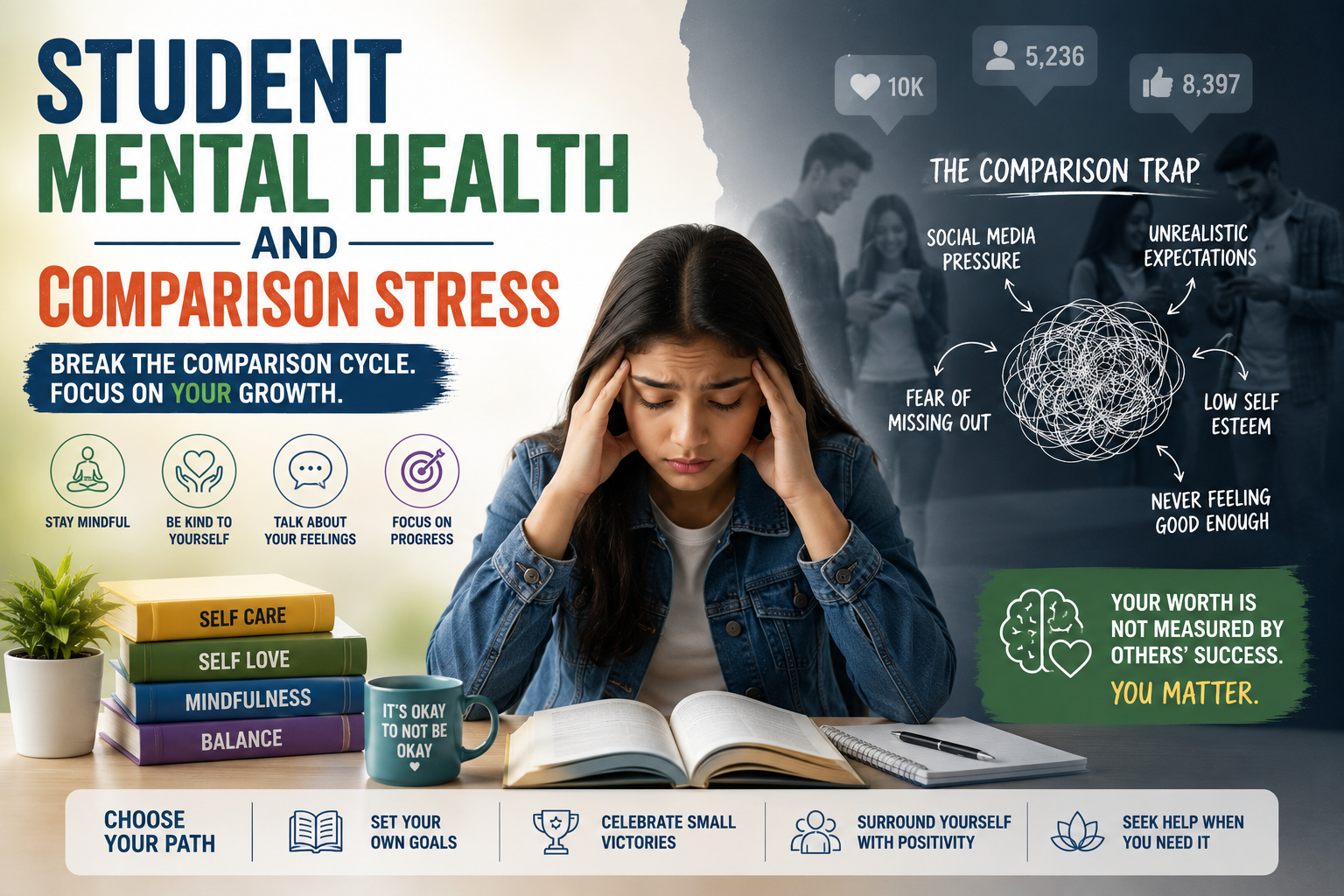
Social media broke that system. Now you compare yourself not to a handful of real people, but to a curated global highlight reel — the single best moment from thousands of lives, stitched together into an impossible standard. Studies consistently link this kind of constant upward comparison to anxiety, low self-confidence, and a creeping sense of “relative deprivation” — the feeling of falling behind even when, by any fair measure, you’re doing fine.
The Specific Traps of 2026
Comparison stress isn’t new. But a few forces have sharpened it for this generation in particular.
The “Study Influencer” Illusion
A uniquely modern phenomenon: creators posting fourteen-hour study days, aesthetic desk setups, colour-coded notes, and daily productivity logs. On the surface, it looks motivating. In practice, it quietly redefines “normal” as “extreme.”
Here’s the part nobody mentions in the reel: six hours of genuinely focused study is excellent. Most people cannot sustain meaningful concentration for fourteen hours, and the few who can are usually not doing fourteen productive hours. You’re watching a performance of studying, not the reality of learning. Feeling guilty for studying “only” six solid hours is like feeling unfit because you can’t match a film montage — the comparison is rigged from the start.
Comparing Your Behind-the-Scenes to Everyone’s Highlight Reel
Every admit post, every offer-letter screenshot, every “I cracked it at 22” update is the summary of a journey — never the rejections, the breakdowns, the gap years, the privately ugly months that came before. You’re comparing your full, unedited reality (including the hard parts only you can see) against other people’s carefully chosen best frame. It is not a fair fight, and it was never meant to be one.
FOMO and the Pressure to Always Be “On”
Research on Indian students points to fear of missing out (FOMO) as a key link between heavy social media use and lower well-being — and it tends to feed on itself. The more anxious you feel about being left behind, the more you scroll to check; the more you scroll, the more evidence you find that you’re “missing out.” It’s a loop that quietly drains your energy, your sleep, and your focus, all while feeling productive.
You Are Not Behind — Because There Is No Single Race
The deepest flaw in comparison anxiety is the assumption underneath it: that everyone is running the same race, on the same track, toward the same finish line, and your position can be ranked.
That race does not exist.
The classmate with the early job offer and the one who takes a gap year and the one who switches fields entirely at 24 are not ahead of or behind each other — they’re on completely different paths with different timelines, strengths, and definitions of “winning.” Plenty of people who peaked impressively at 21 plateaued later; plenty who felt hopelessly behind at 20 found their footing at 27 and never looked back.
Your timeline is yours. Comparing its middle to someone else’s edited highlight tells you nothing useful about where you’re actually headed.
Gentle, Practical Ways to Protect Your Mind
None of this is about pretending the pressure away. It’s about loosening its grip enough to think clearly. A few things that genuinely help:
Curate your feed without guilt. You are allowed to mute, unfollow, or take a break from accounts that reliably leave you feeling worse — even ones you “should” admire. Protecting your attention isn’t weakness; it’s basic maintenance.
Notice the comparison the moment it starts. Just naming it — “ah, I’m comparing my Tuesday to their highlight reel” — strips a surprising amount of its power. You can’t always stop the feeling, but you can stop believing it.
Measure against your own yesterday. Did you understand something today you didn’t last week? Show up when you didn’t want to? That’s real progress, and it’s the only progress that’s actually yours to claim.
Protect your sleep like it’s coursework. Poor sleep and late-night scrolling are two of the most consistent predictors of student anxiety in the research. Charging your phone outside the bedroom is a small change with an outsized effect.
Talk to one real person. The single fastest way to shrink the “everyone’s fine but me” illusion is an honest conversation with one trusted friend. You’ll almost always discover they’re carrying something too. Real connection deflates the comparison far better than any amount of solo coping.
Make space for things that aren’t measured. Not everything has to be optimised, posted, or turned into a productivity metric. A walk, a hobby, an afternoon doing something just because you enjoy it — these aren’t time wasted. They’re part of staying well.
When It’s More Than Stress
There’s an important line between everyday pressure and something that needs real support. Ordinary stress comes and goes. But if low mood, anxiety, hopelessness, or exhaustion has settled in and started affecting your sleep, appetite, relationships, or ability to function for weeks at a time, that’s worth taking seriously — not as a weakness, but the way you’d take a persistent physical symptom seriously.
Reaching out for help is a sign of strength and self-awareness, not failure. Most colleges have counsellors, and there are professional resources designed exactly for this. If you’re struggling and based in India, you can reach the Tele MANAS national mental health helpline at 14416 (or 1800-891-4416), available 24/7. Talking to a campus counsellor, a doctor, or a trusted adult in your life is always a good step. You deserve support, and it exists.
The Bottom Line
The version of you that your feed makes you feel like — perpetually behind, never enough, outpaced by everyone — is a distortion built from highlight reels and rigged comparisons. It is not the truth about your life or your worth.
Nearly half your peers are quietly fighting the same fight. The path isn’t to study fourteen hours or win the comparison game; it’s to step back from a game that was never real to begin with, protect your mind, and run your own timeline at your own pace.
You’re not behind. You’re just looking at the wrong map.
This is a sensitive topic, and an article is no substitute for real support. If you’re going through a hard time, please consider reaching out to a campus counsellor, a trusted person in your life, or the Tele MANAS helpline at 14416. For more student wellbeing, study, and career resources, explore Campus Freshers.