Last updated: 16 November 2026
Quick answer: Layoffs in 2026 are real but uneven. Big employers like BT, Vodafone Germany, PepsiCo, Amazon and Meta have cut thousands of roles. For 2027 freshers, this means fewer easy offers and tougher screening, not zero jobs. Students who show proof of skills, use AI tools well and build a small financial cushion will stand out.
Key highlights
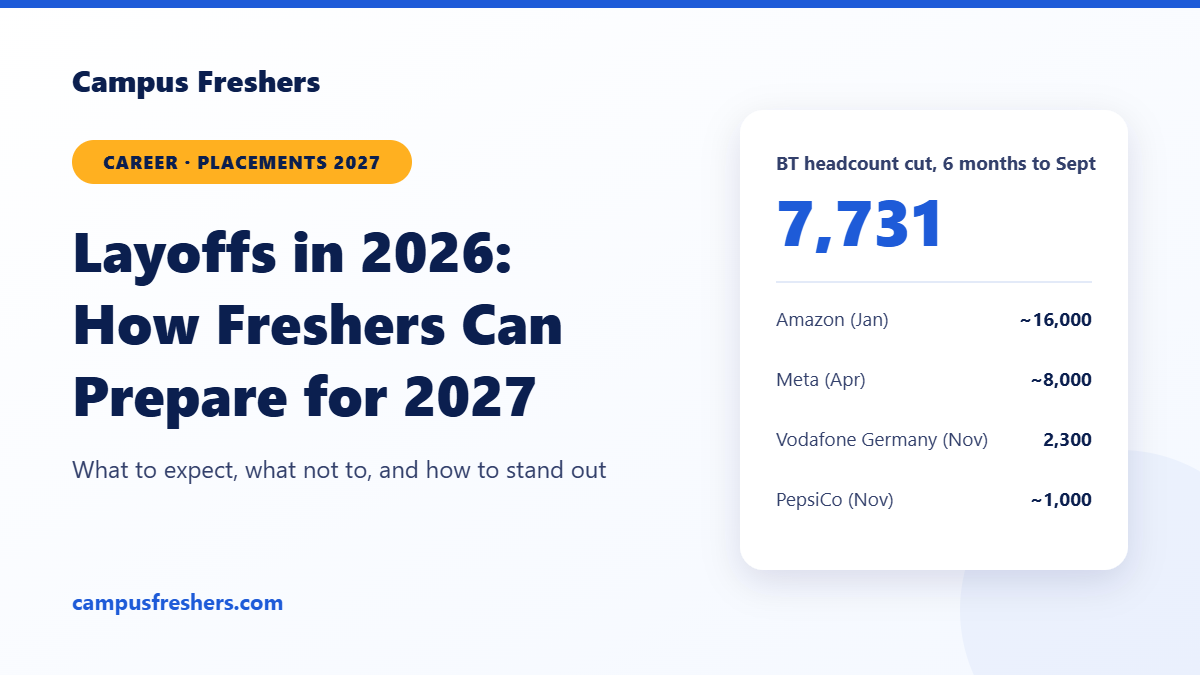
- BT reported on 5 November 2026 that its headcount fell by 7,731 in six months, to about 90,000
- Vodafone said on 10 November 2026 it will cut 2,300 roles in Germany, linking part of it to AI-driven changes
- PepsiCo is cutting about 1,000 jobs in North America, as reported on 11 November 2026
- Earlier in 2026, Amazon announced about 16,000 corporate job cuts (January) and Meta about 8,000 (April)
- Layoff trackers count very differently, so treat any single “global total” you see on social media with caution
- For 2027 campus placements: expect skill-based tests, AI-aware interviews and more internship-to-job routes
How big are the 2026 layoffs, really?
You may have seen viral posts claiming around 3.5 lakh jobs lost across 300+ companies in 2026. We checked the trackers ourselves, and the numbers vary a lot depending on what they count. For example, one US tracker, WorkInsiders, counted 70 announcements and 6,512 US jobs cut in November 2026 up to 15 November, because it includes only US job numbers that companies have stated. Global totals that add up worldwide cuts will be much higher.
So the honest answer is: nobody has a single exact global number. What we can confirm is the company-level news below, taken from reputable business reporting.
Which companies announced job cuts in 2026?
| Company | Sector | What was reported | When |
|---|---|---|---|
| BT Group (UK) | Telecom | Headcount down by 7,731 to about 90,000 in six months; target of 75,000 to 80,000 by 2030 | 5 November 2026 |
| Vodafone (Germany) | Telecom | 2,300 roles to go in Germany as part of cost cutting, with AI cited as one factor | 10 November 2026 |
| PepsiCo (North America) | Food and beverage | About 1,000 jobs to simplify structure after a weaker outlook | 11 November 2026 |
| Meta | Tech | About 10% of staff, around 8,000 jobs, as it focuses spending on AI | April 2026 |
| Amazon | Tech and retail | About 16,000 corporate roles, to cut layers and move faster | January 2026 |
Notice the pattern. Not every cut is because “AI replaced people”. BT’s cuts are mostly linked to slowing fibre rollout and cost targets. PepsiCo cited weak sales. Meta and Vodafone linked changes more directly to AI. The common thread is that companies are cutting costs and spending more on technology, and both trends affect what kind of fresher they hire.
What does this mean for Indian students graduating in 2027?
India is not cut off from global trends. Indian IT services firms depend heavily on clients in the US and Europe, and when those clients cut budgets, hiring plans in India adjust too. TCS, for example, announced in July 2025 that it would reduce roughly 2% of its workforce, mostly in middle and senior roles.
At the same time, companies still need fresh talent because freshers are cost-effective and easier to train in new tools. The shift is in who gets hired and how:
- Mass hiring based only on degree and CGPA is shrinking
- Hiring for specific, tested skills (coding, data, cloud, communication, domain knowledge) is growing
- More offers start as internships or contract roles before conversion
- Interviews now check whether you can work with AI tools, not just whether you know theory
What to expect in 2027 placements
- Fewer roles, more applicants: expect higher competition for each opening, especially in mass recruiter drives.
- Harder online assessments: coding rounds, aptitude and case questions are being used to filter large applicant pools quickly.
- Questions about AI: interviewers may ask how you used AI tools in a project and how you checked the output.
- Delayed joining dates: some companies may give offers but push onboarding, so plan for a gap.
- Growth in non-tech roles that use tech: operations, analytics, sales, compliance and customer roles now expect basic digital and data comfort.
What NOT to expect
- Do not expect a degree alone to get you a job. Marks open the door to shortlists, but skills close the deal.
- Do not expect one big offer to be guaranteed. Apply widely, including off-campus and smaller companies.
- Do not expect AI to “take all jobs”. It is changing tasks inside jobs. People who use it well become more valuable.
- Do not expect viral numbers to be accurate. Check company announcements and trusted news before you panic.
How to reposition yourself for interviews in 2027
Think of your profile as a product that must show value quickly. Here is a simple plan:
- Pick one target role: for example data analyst, software developer, digital marketer or business analyst. Tailor your resume to it.
- Build 2 to 3 proof projects: real problems, real data, hosted on GitHub or a portfolio link. A working project beats a long list of certificates.
- Show AI fluency honestly: mention which AI tools you used, for what, and how you verified the results. Never pass off AI work as fully your own.
- Quantify your impact: write “cut report time from 3 hours to 30 minutes” instead of “worked on Excel reports”.
- Prepare the “why you” answer: in under a minute, connect your skills and projects to the company’s work.
- Practise for skill tests: do timed aptitude, coding or case practice every week from now till placements.
- Get internship experience: even a short, unpaid-to-modest project internship gives you real stories for interviews.
Skills that stay valuable when companies cut costs
| Skill area | Why it matters in 2027 | How to show it |
|---|---|---|
| Data and Excel / SQL | Every function wants decisions backed by data | A dashboard or analysis project with real data |
| Using AI tools well | Companies want people who get more done with AI | A project where AI saved time, with your checks explained |
| Cloud and basic programming | Tech budgets are shifting to cloud and AI | A small app or automation deployed online |
| Communication | Fewer layers means freshers talk to clients and managers sooner | Clear write-ups, presentations, a short demo video |
| Domain knowledge | AI cannot replace understanding of finance, health, law or manufacturing | Projects or internships in one industry |
Should students build an emergency fund or second income?
The general idea makes sense even for students: a job market with layoffs rewards people who are not desperate. You do not need a big amount. Start small:
- Save a little from internship stipends or part-time work, so you have a cushion for the months between graduation and joining.
- Pick up freelance or part-time work that builds skills too, such as tutoring, content writing, design, coding small websites or data entry automation.
- Avoid paying large fees for “guaranteed placement” courses. Check reviews and placement claims carefully.
This is general guidance, not financial advice. Talk to your family or a qualified advisor before making money decisions.
FAQs on layoffs and 2027 jobs for freshers
Are layoffs in 2026 affecting jobs for freshers in India?
Indirectly, yes. Global companies and their Indian partners are hiring more carefully. Freshers are still hired, but selection is stricter and more skill-based.
Is it true that 3.5 lakh jobs were lost worldwide in 2026?
We could not verify that exact figure. Different trackers count different things, such as US-only cuts or tech-only cuts, so totals vary. Company announcements are more reliable.
Will AI take away fresher jobs?
AI is automating some routine tasks, and a few companies have linked job cuts to it. But it also creates demand for people who can use AI tools, check their output and apply them to real work.
Which skills should I learn before 2027 placements?
Focus on one job-ready skill set (like data analysis, software development or digital marketing), basic AI tool use, and strong communication. Build projects that prove each skill.
How do I answer “How do you use AI?” in an interview?
Give one specific example: the task, the tool, what it did, and how you checked or improved its output. This shows both skill and judgement.
Should I go for higher studies to avoid a weak job market?
Only if the course adds real skills or a clear career path. Doing a master’s just to wait out the market can add cost without improving your chances.
Sources
- BT cuts almost 8,000 jobs amid cost-saving programme (5 November 2026)
- Light Reading: Vodafone cuts 2,300 jobs in Germany (10 November 2026)
- Fox Business: PepsiCo to cut about 1,000 North American jobs (11 November 2026)
- NerdWallet: tech layoffs tracker (Meta, Amazon 2026)
- WorkInsiders: November 2026 layoffs tracker (US)