Scoring 90%+ is Not a Guarantee of Career Success
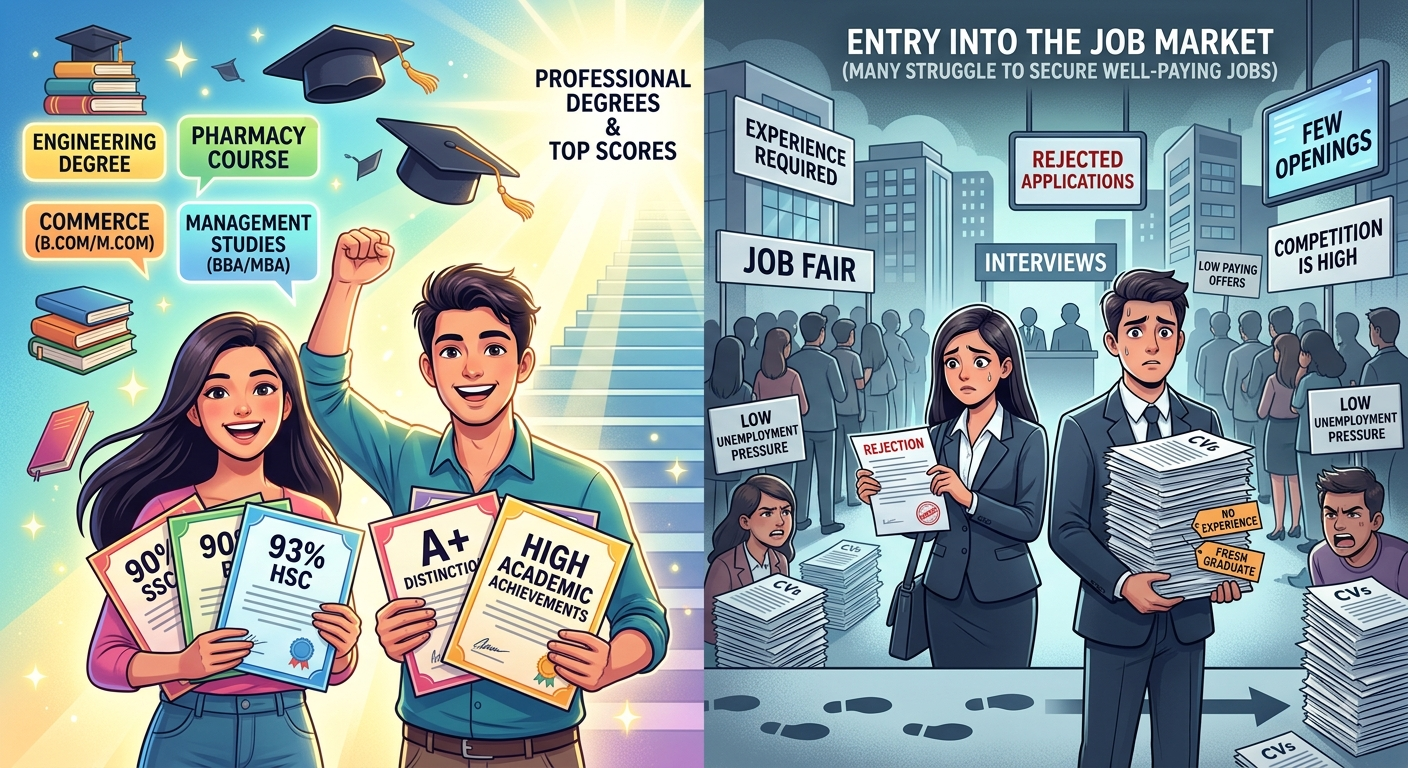
Every year, thousands of students score 90% or more in SSC and HSC. They work hard, get admission to good colleges, and pursue degrees such as engineering, pharmacy, commerce, management, science, arts, and other professional courses.
Yet, after graduation, some of these students find themselves accepting low-salary jobs or struggling to find employment in their field.
This can be confusing.
If a student was among the top performers in school and completed a good degree, why doesn’t that automatically lead to a high-paying career?
The answer is simple: academic performance and employability are not the same thing.
Marks Show Academic Ability—But Employers Look for More
Good marks demonstrate discipline, consistency, and the ability to understand academic subjects. These qualities are valuable, but companies also look for practical skills.
Depending on the career, employers may value:
- Communication skills
- Problem-solving ability
- Technical knowledge
- Industry-specific skills
- Computer and digital skills
- Practical experience
- Internships and projects
- Teamwork and leadership
- Creativity and critical thinking
- Ability to learn new technologies
A student with 90% marks but no practical experience may sometimes compete against another graduate with lower academic scores but strong skills, projects, internships, and communication abilities.
A Degree is a Starting Point, Not the Destination
Choosing a degree is an important decision, but simply obtaining a degree does not guarantee a high salary.
Whether someone studies engineering, B.Com, BBA, pharmacy, science, arts, computer applications, management, or another field, they need to understand what the job market expects.
For example, an engineering student may have a degree but still need skills in programming, data analysis, design software, automation, AI, cybersecurity, or other areas depending on their career goal.
Similarly, a commerce graduate may benefit from skills in accounting software, financial analysis, taxation, business analytics, or digital tools.
The important question is not only:
“Which degree should I choose?”
It should also be:
“What skills will help me build a successful career after this degree?”
The Skills Gap Can Become a Major Problem
One of the biggest challenges students face is the gap between what they learn academically and what companies need in the workplace.
A student may spend years preparing for examinations but very little time working on real-world projects.
As a result, they graduate with a certificate or degree but lack confidence in applying their knowledge.
This is why students should start developing practical skills before graduation, rather than waiting until they begin searching for a job.
Internships and Projects Can Make a Difference
A resume containing only marks and a degree may not stand out.
Practical experience can make a much stronger impression.
Students can build their profiles through:
- Internships
- Freelance projects
- College projects
- Certifications
- Competitions and hackathons
- Part-time work
- Volunteering
- Personal projects
- Industry training
Even a small project can demonstrate that a student knows how to apply their knowledge outside the classroom.
Communication Skills Matter Too
Another overlooked factor is communication.
A highly knowledgeable student may struggle during interviews if they cannot clearly explain their ideas, discuss their projects, or communicate confidently with others.
Good English communication, presentation skills, interview skills, and professional communication can significantly improve career opportunities.
This does not mean students need perfect English. What matters is being able to communicate ideas clearly and confidently.
Students Should Think About Careers, Not Just Degrees
Many students choose a degree because their friends are choosing it, their parents recommend it, or they believe it will guarantee a good salary.
Instead, students should consider:
- What subjects do I enjoy?
- What am I naturally good at?
- What careers are available in this field?
- What skills do those careers require?
- What is the current and future demand for those skills?
- What salary range can I realistically expect?
- What additional skills should I develop?
This approach can help students make more informed decisions about career planning after 12th.
High Marks Are Valuable—But They Are Only One Part of the Formula
Students should not conclude that marks are useless.
Good academic performance matters.
The problem occurs when students believe that marks alone will determine their future income.
A successful career usually requires a combination of:
Education + Skills + Experience + Communication + Networking + Continuous Learning
The exact combination varies from career to career.
What Should Students Do During College?
Instead of waiting until the final year to think about employment, students can start preparing from the beginning of their degree.
First Year
Focus on understanding the industry, improving communication, and exploring different career options.
Second Year
Start developing job-specific technical and practical skills.
Third Year
Take internships, build projects, earn relevant certifications, and create a strong resume.
Final Year
Focus on placements, interviews, networking, and applying for suitable jobs.
This gradual approach can make the transition from college to career much easier.
The Real Meaning of Career Success
A student’s school percentage does not determine their lifetime earning potential.
Someone who scored 90% may earn less initially, while another student with average marks may eventually build a highly successful career. There are countless factors involved.
What matters is what a person does after the marks and degree.
Students should therefore aim for more than just high percentages. They should develop the ability to solve problems, create value, communicate effectively, adapt to change, and continuously learn.
Final Thoughts
Scoring 90% in SSC and HSC is a significant achievement. Completing a degree is also an important milestone. But neither guarantees a high-paying job.
The modern job market rewards students who can combine academic knowledge with practical skills and real-world experience.
So, instead of asking only, “How much percentage do I need?”, students should also ask:
“What skills should I develop to become valuable in the job market?”
That change in mindset could make the difference between simply earning a degree and building a successful career.