Last updated: 27 November 2026
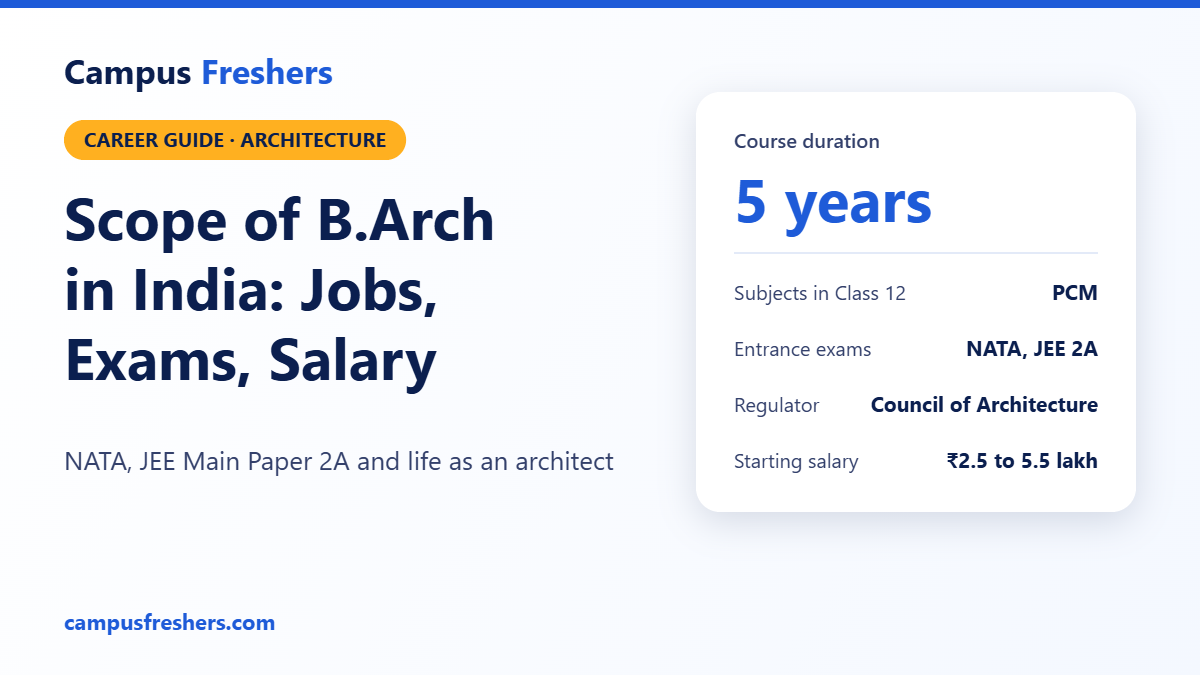
Quick answer: B.Arch is a five-year professional degree that leads to registration as an architect with the Council of Architecture (COA). You need Class 12 with Physics, Chemistry and Mathematics (or a 3-year diploma with Mathematics) and a valid NATA or JEE Main Paper 2A score. Graduates work in design firms, construction, urban planning, interiors and government departments.
Key highlights
- Course length: 5 years, including practical training
- Eligibility: 10+2 with PCM, or 10+3 diploma with Mathematics; most admitting bodies ask for around 50% aggregate
- Entrance exams: NATA (conducted by COA) and JEE Main Paper 2A (conducted by NTA)
- Regulator: Council of Architecture, under the Architects Act, 1972
- Indicative starting salary: about ₹2.5 lakh to ₹5.5 lakh a year
What is B.Arch and who regulates it?
Bachelor of Architecture (B.Arch) trains you to plan and design buildings and spaces that are safe, useful and good to look at. The course mixes design studios, building construction, structures, materials, history of architecture, climate-responsive design, building services, computer-aided design and professional practice. Most colleges also include a semester of practical training in an architect’s office.
Architecture education and practice in India are regulated by the Council of Architecture, set up under the Architects Act, 1972. Only a person registered with COA can call themselves an “architect” and practise under that title, which is why you should always check that your college and course are approved by COA before taking admission.
Am I eligible for B.Arch after Class 12?
The basic route is Class 12 with Physics, Chemistry and Mathematics. Students with a 10+3 diploma that includes Mathematics can also apply. Most counselling bodies and colleges ask for about 50% aggregate marks, and some states relax this to 45% for reserved categories (for example, Karnataka for KCET-based B.Arch admission). There is no upper age limit as per current coaching and admission guides, but always read the brochure of the college or state you are applying to.
Which entrance exams lead to B.Arch admission?
| Exam | Conducted by | What it is used for |
|---|---|---|
| NATA (National Aptitude Test in Architecture) | Council of Architecture | Admission to most B.Arch colleges, including many state and private institutes |
| JEE Main Paper 2A (B.Arch) | National Testing Agency | NITs, SPAs and other centrally funded institutes through JoSAA counselling; some states also use it |
| JEE Advanced + AAT | IITs | B.Arch at the few IITs that offer it, for JEE Advanced qualified candidates |
| State and university tests | States and universities | State-level counselling, such as KCET in Karnataka |
JEE Main Paper 2A has three parts: Mathematics, an Aptitude Test and a Drawing Test. The paper lasts 3 hours 30 minutes, and the Drawing Test is done with pen and paper while the rest is computer based. For 2027, JEE Main Session 1 is from 20 to 28 January and Session 2 is in April. NATA scores are released on nata.in, so check the official NATA brochure for the current year’s dates, pattern and number of attempts.
What jobs can you get after B.Arch?
| Career path | What you do | Where you work |
|---|---|---|
| Architect | Design buildings, prepare drawings, coordinate with engineers and clients | Architecture firms, design studios, own practice |
| Interior architect | Plan interiors, furniture layouts and finishes | Interior design firms, retail and hospitality brands |
| Urban designer or planner (after M.Plan or M.Arch) | Plan neighbourhoods, transport links and public spaces | Development authorities, consultancies, smart city projects |
| Landscape architect (after PG) | Design parks, campuses and green spaces | Landscape firms, municipal bodies |
| BIM and 3D visualisation specialist | Create building models and renders using software | Construction companies, design tech firms |
| Conservation architect (after PG) | Restore heritage buildings | Heritage agencies, specialist consultancies |
| Government architect | Design and supervise public buildings | CPWD, state PWDs, development authorities, PSUs |
How much does an architect earn in India?
Starting salaries vary a lot with the city, the firm and your portfolio. Admission guides put the average starting salary for B.Arch graduates at roughly ₹2.5 lakh to ₹5.5 lakh a year. Pay usually rises with experience, a strong portfolio, software skills such as BIM, and a master’s degree in a specialisation. Architects who start their own practice can earn more, but income depends on projects and takes time to build.
Treat any salary figure as a rough guide. Ask seniors and alumni of the colleges you shortlist about the internships and placements they actually got.
Is B.Arch the right career for you?
B.Arch suits you if you enjoy drawing, building things, solving spatial puzzles and working on long projects. It is a demanding course with studio submissions, late-night model making and frequent juries where you defend your designs. Ask yourself these questions before you choose it:
- Do I enjoy sketching and imagining spaces, not just maths and physics?
- Am I ready for a five-year course with heavy studio work?
- Can I handle feedback and redo designs many times?
- Am I interested in how cities, climate and people shape buildings?
If you like design but want a shorter course, compare B.Arch with B.Des or B.Planning. If you are drawn to the technical side, B.Tech in Civil Engineering is another option.
What should you do next if you want B.Arch?
- Keep PCM in Class 12 and aim for at least 50% aggregate.
- If you have applied for JEE Main 2027, check whether you can add Paper 2A in the correction window open till 29 November; also watch nata.in for the NATA 2027 brochure.
- Practise drawing every day: perspective, shading, proportions and memory drawing.
- Build a small portfolio of sketches and models; it helps in interviews and internships.
- Shortlist COA-approved colleges and note which entrance exam each one accepts.
Frequently asked questions
Is maths compulsory for B.Arch?
Yes. You need Mathematics in Class 12 along with Physics and Chemistry, or a 10+3 diploma that includes Mathematics. JEE Main Paper 2A also has a mathematics section.
Can I get B.Arch admission without NATA?
Yes, through JEE Main Paper 2A for NITs, SPAs and other institutes in JoSAA, or through state and university tests that accept it. Many private and state colleges still require NATA, so check each college.
How many years is B.Arch?
B.Arch is a five-year course. It usually includes a period of practical training in an architecture office.
Do I need to register with the Council of Architecture?
Yes, to practise and use the title “architect” in India, you must register with COA after completing a recognised architecture degree.
What is the starting salary after B.Arch?
Admission guides list an average starting salary of about ₹2.5 lakh to ₹5.5 lakh a year. It depends heavily on the city, the firm and your portfolio.
What can I study after B.Arch?
Popular options are M.Arch in specialisations like urban design, landscape, conservation or sustainable architecture, and M.Plan. Some graduates also take up project management or construction management courses.
Official links and sources
- Council of Architecture (official website)
- NATA official website
- JEE Main official website (NTA)
- NTA notice: JEE (Main) 2027 Session 1, paper pattern for Paper 2A
- Careers360: NATA eligibility criteria
- PW: B.Arch admission guide