Last updated: 20 November 2026
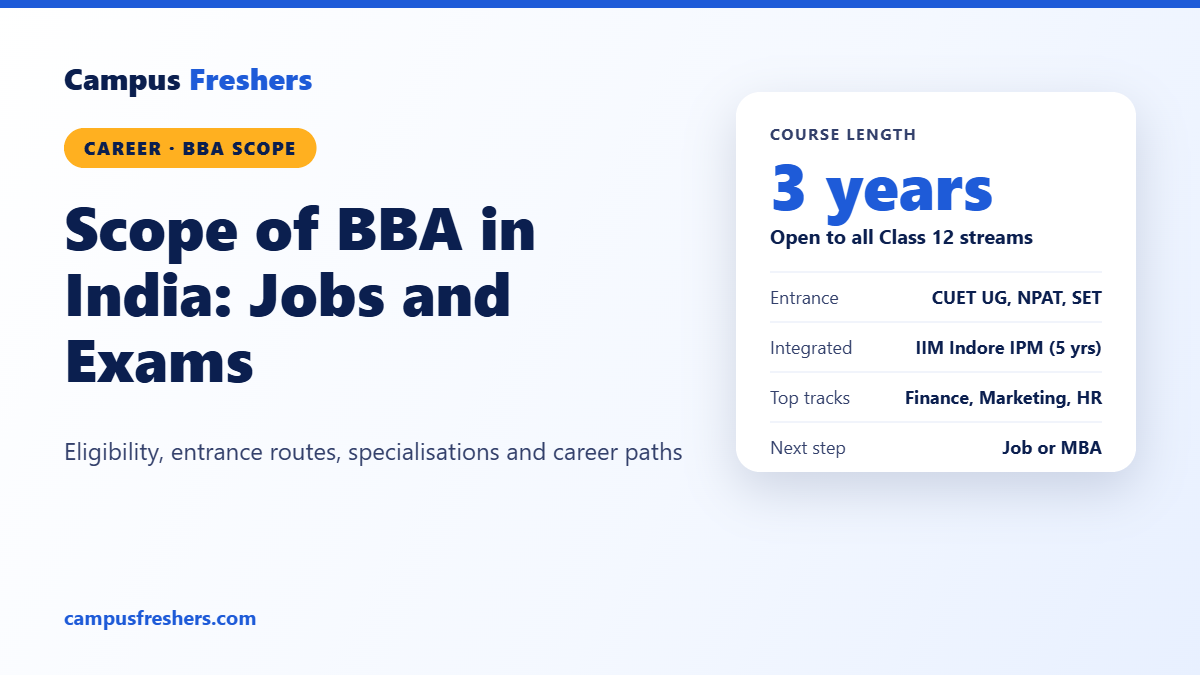
Quick answer: BBA is a three-year undergraduate management degree open to students from any Class 12 stream. It leads to entry-level roles in sales, marketing, finance, HR, operations and business analytics, and is a strong base for an MBA. Admission is through exams such as CUET UG, NPAT and SET, or through merit at many colleges.
Key highlights
- Course: Bachelor of Business Administration, usually three years (some universities offer a four-year honours option)
- Eligibility: Class 12 pass from any stream; individual colleges set their own minimum marks
- Main entrance routes: CUET UG (central and participating universities), NPAT (NMIMS), SET (Symbiosis) and college-level tests
- Integrated option: IIM Indore’s five-year programme awards a BA (Foundations of Management) and an MBA
- Popular specialisations: finance, marketing, HR, international business, business analytics, FinTech
- Next steps after BBA: job, MBA, or professional certifications
What is BBA and who should choose it?
BBA, or Bachelor of Business Administration, teaches you how organisations work: how they sell, manage money, hire people, run operations and make decisions. In the first year you study basics such as principles of management, business economics, accounting, business communication and statistics. Later years let you go deeper into an area like marketing or finance through electives and a specialisation.
It suits students who like working with people, enjoy problem-solving and want to start a business career early. Because most BBA programmes accept students from science, commerce and humanities, it is also a popular switch for those who do not want to continue in their Class 12 stream.
What is the eligibility for BBA in India?
The basic requirement is passing Class 12 from a recognised board. Many colleges do not insist on mathematics. For example, NMIMS lists its BBA, BBA (Branding and Advertising), BBA (International Business) and BBA (Management and Marketing) programmes among those you can apply to without maths. Minimum marks and subject rules differ from college to college, so always read the admission page of each institute you apply to.
Which entrance exams lead to BBA admission?
There is no single national BBA entrance exam. Instead, you will come across a mix of common tests and university-specific tests:
| Exam / route | Conducted by | Used for |
|---|---|---|
| CUET UG | National Testing Agency (NTA) | UG admissions, including management courses, at central universities and participating state, deemed and private universities |
| NPAT | NMIMS | BBA and its variants (FinTech, Finance, International Business, Branding and Advertising and more), B.Com, B.Sc Finance and Economics, Integrated BBA-MBA |
| SET | Symbiosis International (Deemed University) | BBA (Honours), BBA Global Dual Degree, BBA (Media Management), BBA (IT), BBA (AI) and other Symbiosis programmes |
| IIM Indore IPM entrance test | IIM Indore | Five-year Integrated Programme in Management (BA + MBA) |
| Merit or college test | Individual colleges and state universities | Many private and state colleges admit on Class 12 marks or their own test and interview |
A few useful details from the official pages: NPAT lets you apply to up to five programmes and allows one main attempt plus two retakes, with your best score counted. Symbiosis SET is a one-hour online test of 60 objective questions with no negative marking, and its score is used to shortlist candidates for group discussion, interview and writing rounds. Check the current year’s dates and fees on each official website before applying.
Is an integrated BBA-MBA better than a regular BBA?
Integrated programmes combine undergraduate and postgraduate management study in one go. IIM Indore’s Integrated Programme in Management runs for five years: the first three years build foundations, and the last two follow the same courses as its two-year PGP. On completion, students receive a Bachelor of Arts (Foundations of Management) and an MBA, and there is an exit option after the third year. NMIMS also offers an Integrated BBA-MBA through NPAT.
The upside is that you skip a separate MBA entrance test later. The trade-off is that you commit early and miss the chance to gain work experience before your master’s, which many top B-schools value. If you are unsure about management as a long-term path, a regular BBA keeps more doors open.
What jobs can you get after BBA?
BBA graduates usually start in entry-level business roles. Your specialisation, internships and skills shape where you land. Here is a quick map:
| Specialisation | Common starting roles | Skills that help |
|---|---|---|
| Marketing | Sales executive, marketing associate, digital marketing executive, brand trainee | Communication, social media tools, basic analytics |
| Finance | Financial analyst trainee, credit or banking associate, accounts executive | Excel, financial statements, valuation basics |
| Human resources | HR executive, talent acquisition associate, payroll executive | People skills, labour law basics, HR software |
| Business analytics | Business analyst, MIS executive, data analyst trainee | Excel, SQL, Power BI or Tableau |
| International business | Export-import executive, logistics coordinator, trade operations associate | Documentation, supply chain basics, a foreign language |
| Entrepreneurship | Family business, startup roles, your own venture | Finance basics, selling, problem-solving |
Starting pay varies widely by college, city, company and role, so treat any single “average BBA salary” figure with caution. The quality of your internships and the skills you can prove in an interview usually matter more than the degree title alone.
What can you study after BBA?
- MBA or PGDM: the most common path, through exams such as CAT, XAT, CMAT and others. Many students work for two or three years first.
- Specialised master’s: options such as a master’s in finance, business analytics or international business, in India or abroad.
- Professional certifications: finance, digital marketing, HR analytics or project management credentials can add weight to your CV.
- Government jobs: as a graduate you can appear for bank, SSC and UPSC exams, subject to each exam’s eligibility rules.
Is BBA the right course for you?
Ask yourself three honest questions before you choose:
- Do I enjoy working with people and ideas more than deep technical subjects? BBA rewards communication, teamwork and initiative.
- Am I ready to build skills outside the classroom? Internships, competitions, clubs and certifications make a big difference to BBA placements.
- Is the college worth it? Look at faculty, internship support, alumni and real placement reports, not just brochures.
If you answered yes to most of these, BBA can be a smart, flexible start to a business career.
FAQs on BBA in India
Can a science student do BBA?
Yes. Most BBA programmes accept students from science, commerce and humanities. Science students often do well in business analytics and finance electives.
Is maths compulsory for BBA?
Not always. Several colleges, including NMIMS for many of its BBA programmes, accept students without maths in Class 12. Some specialised programmes, such as finance or FinTech, may require it, so check each college’s rules.
Is CUET compulsory for BBA admission?
Only for universities that admit through CUET UG, such as central universities and participating institutions. Private universities like NMIMS and Symbiosis use their own tests, and many colleges admit on merit.
BBA or B.Com: which is better?
BBA focuses on management and business functions, while B.Com goes deeper into accounting, taxation and commerce. Choose BBA if you see yourself in management roles or an MBA; choose B.Com if you are interested in CA, CMA or accounting careers.
Should I do an MBA right after BBA?
You can, but many students benefit from two or three years of work first. Work experience helps you pick the right MBA specialisation and is valued by many top B-schools.
Can I do BBA through distance or online mode?
Yes, several universities offer online or distance BBA programmes. Before enrolling, confirm on the UGC website that the university is approved to offer that programme in that mode.
Official links and sources
- CUET UG official website (NTA)
- NMIMS NPAT official website
- Symbiosis Entrance Test (SET) official website
- IIM Indore Integrated Programme in Management