Last updated: 17 November 2026
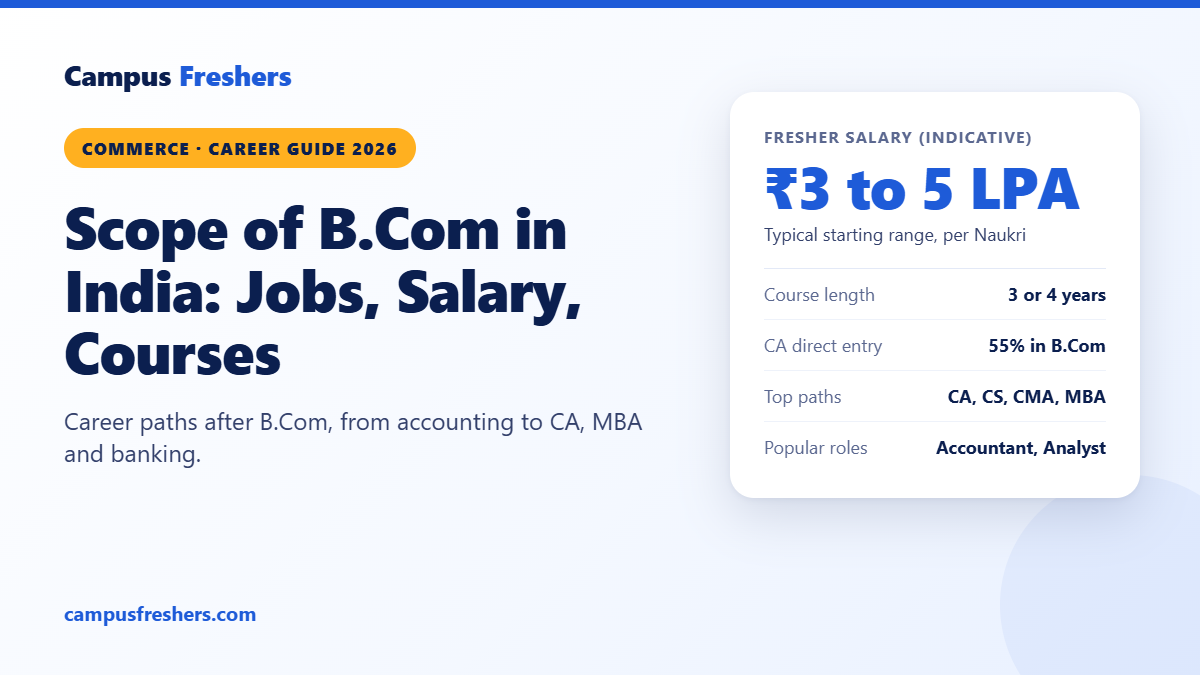
Quick answer: B.Com has wide scope in India because almost every business needs people who understand accounts, tax and finance. Freshers usually start as accountants, audit or tax assistants, or finance executives, with typical starting pay of about ₹3 to 5 lakh a year. Adding CA, CS, CMA, an MBA or a strong skill like financial analysis raises your ceiling sharply.
Key highlights
- Course: Bachelor of Commerce, usually 3 years; many universities also offer a 4 year honours option under NEP
- Who can apply: Students who have passed Class 12, mainly from commerce, though many colleges accept other streams
- Typical fresher pay: about ₹3 to 5 LPA, as per Naukri Campus’s salary guide
- Big career boosters: CA, CS, CMA, MBA, CFA or ACCA, and skills like Excel, Tally and financial modelling
- CA shortcut: Commerce graduates with at least 55% marks can enter CA Intermediate directly under ICAI’s direct entry route
What is B.Com and who should take it?
B.Com (Bachelor of Commerce) is an undergraduate degree that covers accounting, business law, economics, taxation, finance and management. Popular variants include B.Com (General), B.Com (Hons), and specialised options such as B.Com in Accounting and Finance, Banking and Insurance, or Taxation.
It suits you if you like numbers, are curious about how businesses earn and spend money, and are comfortable with steady, detail-focused work. You do not need to be a maths topper, but you should be fine with daily calculations and reading financial statements.
What is the scope of B.Com in India?
The scope is broad for one simple reason: every company, from a small trader to a large bank, needs people to keep its books, file its taxes and plan its money. That gives B.Com graduates options in:
- Accounting and audit: CA firms, audit firms and company finance teams
- Taxation: GST and income tax filing, tax consultancy
- Banking and financial services: private banks, NBFCs, insurance, mutual funds
- Corporate finance and analysis: budgeting, reporting and financial analysis roles
- Government jobs: bank exams, SSC and state exams that accept any graduate
- Business and startups: running or growing a family business, or starting your own
The honest catch: a plain B.Com with no extra skill or qualification often leads to modest starting pay. The students who grow fastest add a professional course or a job-ready skill alongside the degree.
What salary can a B.Com graduate expect?
Salaries vary a lot by city, employer and skills. The ranges below come from Naukri Campus’s B.Com (Hons) salary guide and are only indicative:
| Job role | Indicative salary (per year) |
|---|---|
| Accountant | ₹3 to 5 lakh |
| Auditor | ₹4 to 7 lakh |
| Financial Analyst | ₹4 to 8 lakh |
| Tax Consultant | ₹5 to 9 lakh |
| Corporate Finance Executive | ₹6 to 12 lakh |
| Investment Banker | ₹10 to 20 lakh |
By experience, the same guide puts freshers at about ₹3 to 5 lakh, mid-level professionals (2 to 5 years) at about ₹6 to 10 lakh, and senior professionals (5+ years) at ₹12 to 20 lakh or more. Higher-paying roles like investment banking usually need a top MBA, CA or CFA, not just a B.Com.
Which courses can you do after B.Com?
Chartered Accountancy (CA)
The most popular route. Under ICAI rules, commerce graduates with at least 55% marks (60% for other streams) can skip Foundation and register directly for CA Intermediate. You still need to complete practical training and the Final exam.
Company Secretary (CS) and Cost and Management Accountant (CMA)
CS focuses on company law and corporate compliance, while CMA focuses on costing and management accounting. Both are run by their own institutes (ICSI and ICMAI) and pair well with a B.Com.
MBA
An MBA in finance, marketing or HR can move you into management roles. Entrance routes include CAT, XAT, CMAT and others.
M.Com and research
Good for those who want to teach or do research. Clearing UGC NET opens doors to assistant professor roles and junior research fellowships.
Global finance certifications
CFA and ACCA are popular with students aiming for investment, equity research or international accounting roles.
Which skills make a B.Com fresher job-ready?
- Excel: formulas, pivot tables and basic dashboards
- Accounting software: Tally or similar tools used by small and mid-size firms
- GST and income tax basics: filing returns and reading notices
- Financial statement analysis: reading a balance sheet and profit and loss account
- Communication: clear emails and simple presentations
- An internship: even two months in a CA firm or finance team makes your CV stand out
Is B.Com the right career for you?
Ask yourself three questions:
- Do I enjoy working with numbers and organised data most days?
- Am I willing to add a professional course or skill alongside or after the degree?
- Am I patient with a slower start in exchange for strong growth later?
If you said yes to most of these, B.Com is a solid choice. If you prefer coding, design or lab work, look at options like BCA, B.Des or B.Sc instead.
What should B.Com students do next?
- First year: Pick your track early (CA, CS, CMA, MBA or a job) and start learning Excel and Tally.
- Second year: Take an internship in an audit firm, bank or company finance team.
- Final year: Prepare for your chosen entrance or professional exam, and apply for campus placements and off-campus roles.
FAQs
Is B.Com a good course for the future?
Yes, as long as you build on it. Accounting, tax and finance skills are needed in every industry, but pairing the degree with CA, CS, CMA, MBA or strong practical skills makes the biggest difference.
What is the starting salary after B.Com in India?
Naukri Campus puts typical fresher pay at about ₹3 to 5 lakh a year. Your actual offer depends on the city, the employer and the skills you bring.
Can I do CA after B.Com?
Yes. Under ICAI’s direct entry route, commerce graduates with at least 55% marks can register directly for CA Intermediate. Check the latest rules on the ICAI website before registering.
Which is better after B.Com: MBA or CA?
Neither is better for everyone. CA suits those who enjoy accounts, audit and tax, while an MBA suits those who want management roles in finance, marketing or HR.
Can a B.Com graduate get a government job?
Yes. B.Com graduates can apply for bank PO and clerk exams, SSC exams and many state government posts that require any graduate degree.
Is maths compulsory for B.Com?
It depends on the university. Many colleges accept students without Class 12 maths for B.Com (General), but some B.Com (Hons) programmes ask for maths, so check each college’s eligibility.
Sources and useful links
- Naukri Campus: B.Com Honours salary in India
- Taxmann: CA admission FAQs (ICAI direct entry rules)
- ICAI official website