Last updated: 16 November 2026
Quick answer: Choose B.Des at NIFT if you enjoy drawing, visual ideas and making things by hand, because the Creative Ability Test and a hands-on Situation Test decide most of your rank. Choose B.FTech if you have Maths in Class 12 and like numbers, processes and production, since admission rests fully on the GAT.
Key highlights
- Both are 4-year undergraduate programmes offered through the NIFT Entrance Examination (NIFTEE), conducted by NTA
- B.Des has seven specialisations; B.FTech has one, Apparel Production
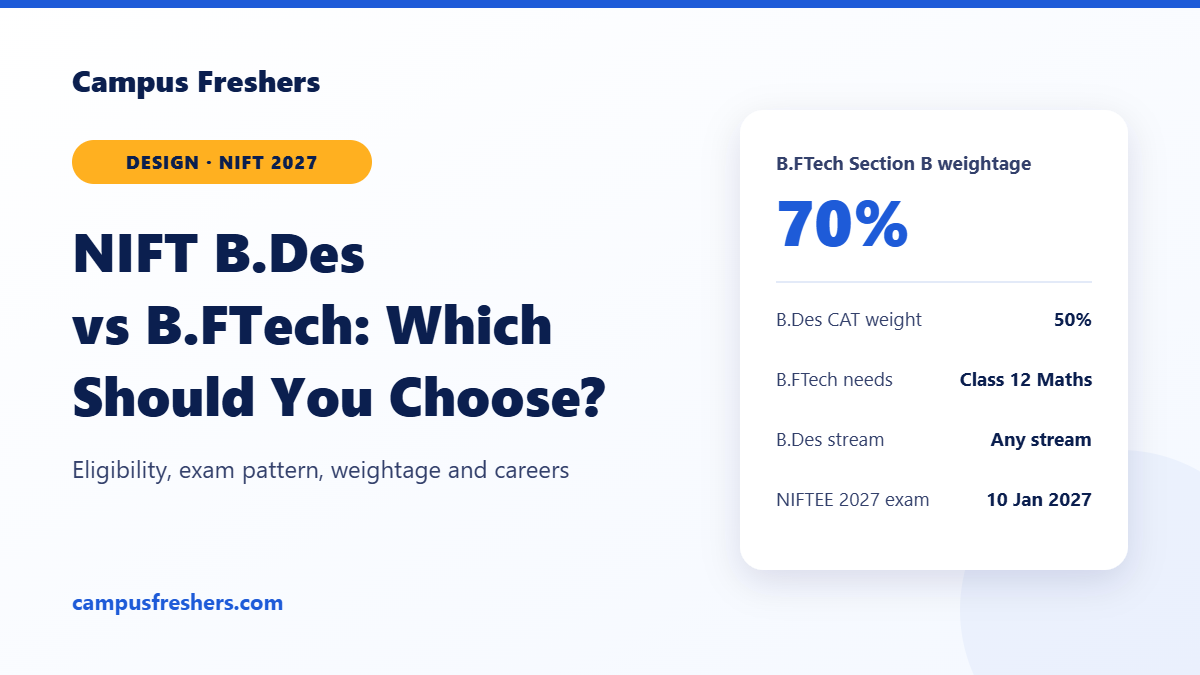
- B.Des is open to Class 12 students from any stream; B.FTech needs Mathematics
- B.Des final merit: GAT 30%, CAT 50%, Situation Test 20%; B.FTech: GAT Section A 30%, Section B 70%
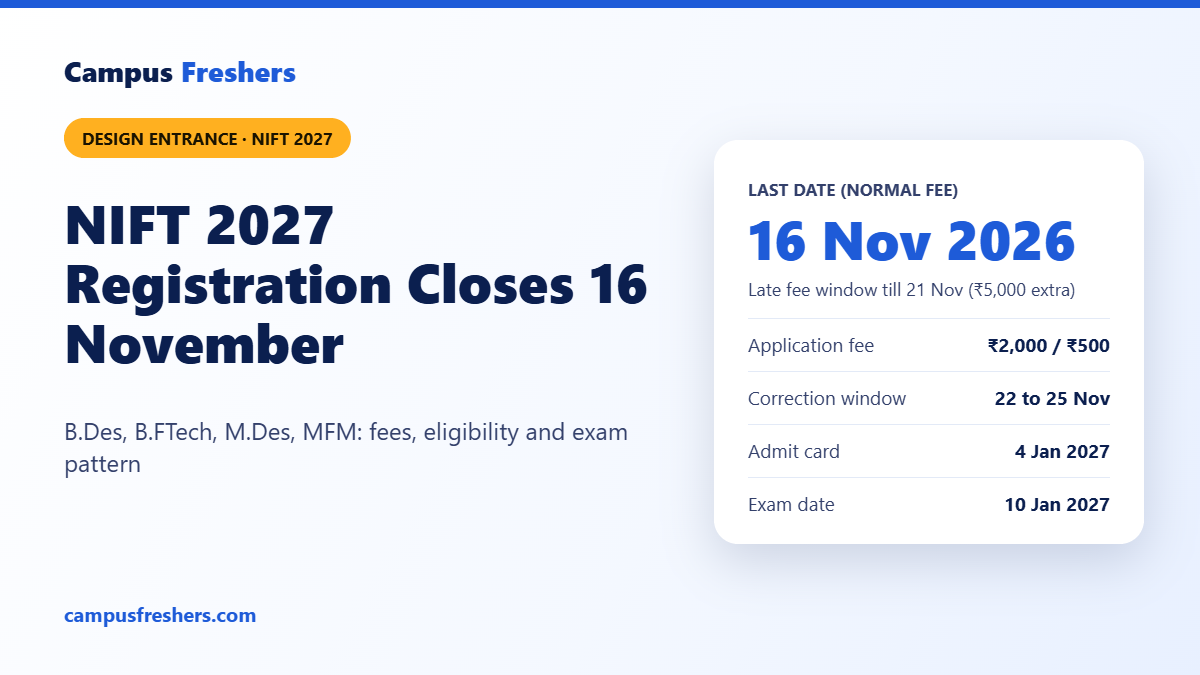
- NIFTEE 2027 is scheduled for 10 January 2027, and registration with the normal fee is open till 24 November 2026
What is the basic difference between B.Des and B.FTech?
Think of it this way: B.Des trains you to create a product, and B.FTech trains you to make that product efficiently, at scale and at the right quality. A B.Des student might design a jacket, a handbag or a brand campaign. A B.FTech student learns how a factory turns that jacket into thousands of pieces, how to plan the line, control quality and manage cost.
Both degrees come from the same institute, share the same entrance exam, and lead into the fashion and lifestyle industry. The day-to-day work, the skills tested at admission and the kind of student who enjoys each course are quite different, though.
B.Des vs B.FTech at NIFT: side-by-side comparison
| Point | B.Des | B.FTech |
|---|---|---|
| Duration | 4 years | 4 years |
| Specialisations | Fashion Design, Fashion Communication, Accessory Design, Knitwear Design, Leather Design, Textile Design, Fashion Interiors | Apparel Production |
| Class 12 subjects | Any stream | Mathematics required |
| Diploma route | 3 or 4 year diploma recognised by AICTE or a State Board | 3 or 4 year engineering diploma recognised by AICTE or a State Board |
| Stage 1 papers | GAT (100 questions, 2 hours) + CAT (3 hours, pen and paper) | GAT Section A (100 questions, 2 hours) + Section B (50 questions, 1 hour) |
| Stage 2 | Situation Test (hands-on model making) | None |
| Final weightage | GAT 30%, CAT 50%, Situation Test 20% | GAT Section A 30%, Section B 70% |
| Suits students who | Love sketching, colour, materials, visual storytelling | Like Maths, logic, systems and problem solving |
All figures above are from the NIFTEE 2027 information bulletin released by NTA. The age limit for both is below 24 years as on 1 August of the year of admission, with five years of relaxation for SC, ST and PwD candidates.
How is the entrance exam different for each course?
B.Des students write the General Ability Test (GAT) and the Creative Ability Test (CAT). The GAT has 100 questions: 40 on communication and English, 20 quantitative, 15 analytical and 25 general knowledge. The CAT is a 3-hour drawing paper that checks observation, concept development, design ability and creative use of colour and illustration. You bring your own colours and drawing material.
Shortlisted B.Des candidates then take the Situation Test, where you build a 3D model from materials NIFT provides and write a short note on your idea in English. It is marked out of 100: 50 for the model, 20 for the write-up and 30 for overall presentation.
B.FTech students write only the GAT, but with an extra Section B of 50 questions: 15 quantitative, 15 analytical and 20 case study questions. Section B alone carries 70% of the final weightage, so case study and maths practice matter a lot.
In both GAT papers, each right answer gets +1 and each wrong answer costs 0.25 marks.
Can I apply for both B.Des and B.FTech?
Yes, if you have Mathematics in Class 12. You can pick both programmes in the same NIFTEE application. On exam day you take GAT Sections A and B from 9:00 AM to 12:00 noon and the CAT from 3:00 PM to 6:00 PM (IST). Your B.Des merit is then worked out from GAT Section A, CAT and the Situation Test.
For NIFTEE 2027, the fee for two programmes is ₹3,000 for Open, EWS and OBC (NCL) candidates and ₹750 for SC, ST and PwD candidates, compared with ₹2,000 and ₹500 for one programme.
What do you study and where can each degree take you?
In B.Des, the first year usually builds drawing, design fundamentals and material understanding, after which you go deep into your specialisation. Graduates commonly work as fashion or textile designers, accessory designers, visual merchandisers, stylists, communication and brand designers, or start their own labels.
In B.FTech, you study apparel manufacturing, production planning, industrial engineering, quality control and the technology used in garment factories. Graduates typically move into roles such as production or merchandising executives, quality and compliance specialists, sourcing and supply chain roles, or technology positions in apparel and retail companies. Some go on to an MBA or NIFT’s MFM or MFTech programmes.
Salaries in both fields vary widely by campus, role, company and your portfolio, so treat any single figure you see online with caution and look at NIFT’s own placement reports where available.
Is B.Des or B.FTech right for you?
Ask yourself these questions honestly:
- Do you sketch, paint or make things in your free time without anyone asking? B.Des will likely feel natural.
- Do you enjoy puzzles, numbers and figuring out how things work in a system? B.FTech may suit you better.
- Did you skip Mathematics in Class 12? Then B.Des is your route at NIFT.
- Are you unsure? If you have Maths, apply for both and keep your options open until results.
- Are you ready for hands-on work? B.Des demands studio hours and model making, while B.FTech involves factory visits and industry internships.
What should NIFT 2027 aspirants do next?
- Apply on the NTA NIFTEE portal before 24 November 2026 to avoid the ₹5,000 late fee.
- Decide whether to pick one programme or both while filling the form.
- Start daily GAT practice with a timer, keeping the 0.25 negative marking in mind.
- B.Des aspirants: sketch every day and try a few paper or card models at home for the Situation Test.
- B.FTech aspirants: solve case study and data interpretation sets regularly, since Section B carries 70% weightage.
FAQs on NIFT B.Des vs B.FTech
Can a commerce or arts student apply for B.Des at NIFT?
Yes. B.Des needs Class 12 from a recognised board in any stream. Only B.FTech requires Mathematics.
Is B.FTech the same as B.Tech?
No. B.FTech (Bachelor of Fashion Technology) at NIFT focuses on apparel production and the fashion industry. It is a separate degree from a regular B.Tech, although it is also technology and process oriented.
Is there a drawing test for B.FTech?
No. B.FTech admission is based only on the GAT (Sections A and B). The CAT drawing test and Situation Test are for B.Des.
Which is harder to get into, B.Des or B.FTech?
It depends on your strengths. B.Des rewards creative and drawing ability, as the CAT carries 50% weightage, while B.FTech rewards quantitative and analytical skills through Section B. Pick the one that matches what you are good at.
What is the age limit for NIFT B.Des and B.FTech?
For both, you must be below 24 years as on 1 August of the year of admission. SC, ST and PwD candidates get five years of relaxation.
When is the NIFT 2027 exam?
NIFTEE 2027 is scheduled for 10 January 2027 as per the NTA bulletin, which marks dates as tentative. Always confirm the latest schedule on the official NTA website.
Official links and sources
- NIFTEE 2027 official portal (NTA)
- NIFTEE 2027 information bulletin (NTA)
- NTA notice, 14 November 2026: NIFTEE 2027 registration extension