Last updated: 12 November 2026
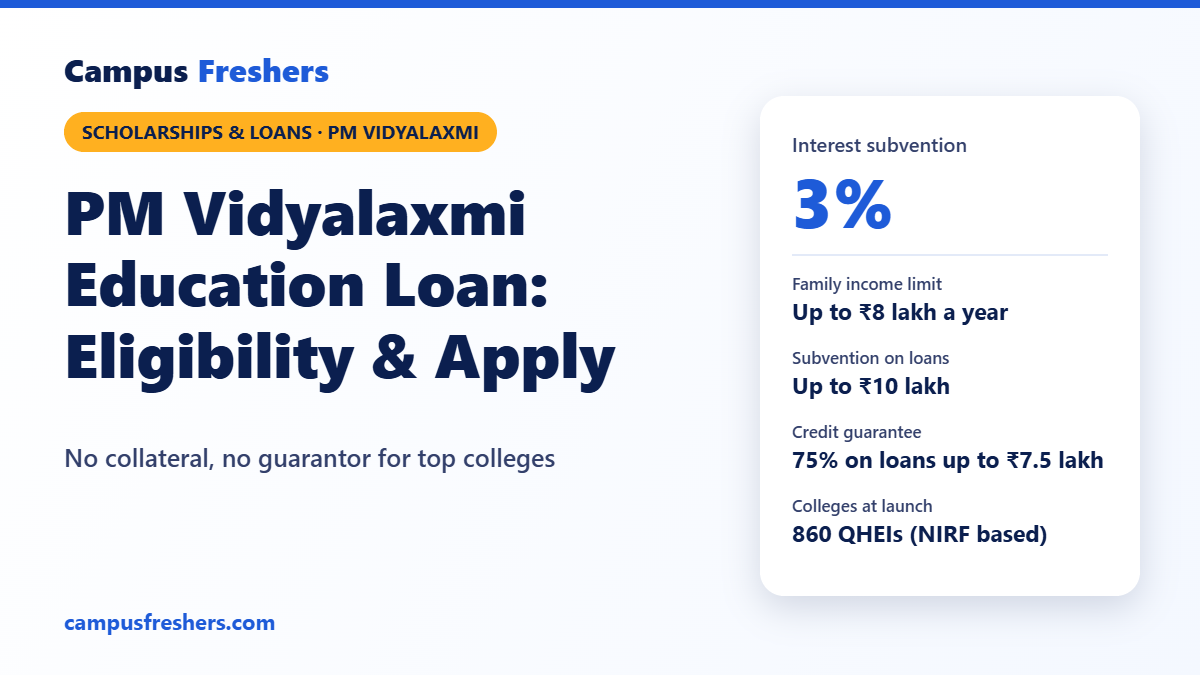
Quick answer: PM Vidyalaxmi is a central government scheme that helps students admitted to top-ranked Indian colleges get education loans without collateral or a guarantor. Students with family income up to ₹8 lakh a year can also get 3% interest subvention on loans up to ₹10 lakh. You apply online through the PM-Vidyalaxmi portal.
Key highlights
- Who can use it: students admitted to a Quality Higher Education Institution (QHEI) as defined using NIRF rankings
- No collateral, no guarantor: loans can cover full tuition fees and other course-related expenses
- Credit guarantee: the Government of India gives banks a 75% credit guarantee on loans up to ₹7.5 lakh
- Interest subvention: 3% during the moratorium period on loans up to ₹10 lakh, for family income up to ₹8 lakh a year
- Scale: ₹3,600 crore outlay from 2024-25 to 2030-31; started with 860 QHEIs
- Where to apply: the unified PM-Vidyalaxmi portal, pmvidyalaxmi.co.in
What is the PM Vidyalaxmi scheme?
The Union Cabinet approved PM Vidyalaxmi on 6 November 2024 as a Central Sector scheme linked to the National Education Policy 2020. Its goal is simple: a student who gets into a good college should not have to drop the seat because the family cannot pledge property or find a guarantor for a bank loan.
Under the scheme, banks and financial institutions give collateral-free and guarantor-free education loans to students who have secured admission in eligible institutions. The government backs these loans with a partial credit guarantee, which makes banks more willing to lend, and it also pays part of the interest for students from lower and middle income families.
Which colleges are covered?
The scheme works only for students admitted to a Quality Higher Education Institution (QHEI). According to the Cabinet decision, QHEIs include:
- All government and private higher education institutions ranked in the top 100 of NIRF, in the overall, category-specific or domain-specific rankings
- State government institutions ranked 101 to 200 in NIRF
- All central government institutions
The scheme began with 860 QHEIs, and the list is updated every year based on the latest NIRF rankings. So before you rely on this scheme, check whether your college appears in the current list on the portal.
PM Vidyalaxmi benefits at a glance
| Feature | What you get | Who qualifies |
|---|---|---|
| Collateral-free loan | Loan for full tuition and course-related expenses without collateral or guarantor | Students admitted to a QHEI |
| Credit guarantee | Government covers 75% of outstanding default for the bank | Loans up to ₹7.5 lakh |
| Interest subvention | 3% interest support during the moratorium period | Family income up to ₹8 lakh a year, loans up to ₹10 lakh, not covered by another government scholarship or interest subvention scheme |
| Full interest subvention (PM-USP CSIS) | Full interest support during the moratorium | Family income up to ₹4.5 lakh a year, technical or professional courses at approved institutions, loans up to ₹10 lakh |
| Payment mode | Subvention is paid through e-vouchers and CBDC (digital rupee) wallets | Eligible students |
Who gets the 3% interest subvention?
The 3% interest subvention is limited to one lakh students every year. It is meant for students whose annual family income is up to ₹8 lakh and who are not already getting benefits under another government scholarship or interest subvention scheme. Preference is given to students from government institutions who have opted for technical or professional courses.
If your family income is up to ₹4.5 lakh, you may be eligible for full interest subvention during the moratorium under the existing PM-USP Central Sector Interest Subsidy (CSIS) scheme. The government describes PM Vidyalaxmi as a supplement to that scheme and to the Credit Guarantee Fund Scheme for Education Loans, so the two work together.
How to apply for a PM Vidyalaxmi education loan
- Get your admission confirmed in an eligible institution and keep the admission letter and fee structure ready.
- Register on pmvidyalaxmi.co.in with your name, email and mobile number, and verify the OTPs to get a student ID. Use only the official government portal.
- Fill the Common Education Loan Application Form (CELAF) with personal, course, cost and repayment details. Keep your PAN handy; Aadhaar verification is needed to receive scheme benefits.
- Upload documents such as ID proof, admission letter, fee structure, marksheets, entrance exam result (if any), income proof and address proof.
- Choose banks: the portal lets you send your application to up to three banks.
- Track the application on the portal and respond quickly if a bank asks for more documents.
- Apply for interest subvention through the portal after your loan is sanctioned and disbursed, with your income certificate.
Interest rates, loan limits beyond the scheme cover and repayment terms are decided by the bank you choose, so compare offers before you accept a sanction letter.
Is this scheme right for you?
PM Vidyalaxmi is most useful if you have a confirmed seat in a top NIRF-ranked or central government institution and your family cannot offer property as security. It is less useful if your college is not on the QHEI list, or if you already get a full scholarship. Remember that an education loan is still a loan: the subvention reduces interest during the moratorium, but you will repay the principal and remaining interest after the course. Borrow only what you need for fees and essential costs.
FAQs on PM Vidyalaxmi
Is the PM Vidyalaxmi education loan completely free?
No. It is a regular bank loan without collateral or a guarantor. Eligible students get 3% interest subvention during the moratorium, but the loan must be repaid as per the bank terms.
Can a student of any college apply?
No. Only students admitted to a Quality Higher Education Institution, decided using NIRF rankings and central government status, are covered. The list is updated every year.
What is the family income limit for interest subvention?
Annual family income should be up to ₹8 lakh for the 3% subvention. Students with family income up to ₹4.5 lakh may get full interest subvention under PM-USP CSIS for technical or professional courses.
How many banks can I apply to on the portal?
The student guide for the portal allows you to choose up to three banks for one application. Each bank verifies your documents separately before sanction.
Is PM Vidyalaxmi available for studying abroad?
The scheme is linked to QHEIs, which are Indian institutions ranked under NIRF or run by the central government. For foreign universities, check with banks for their regular education loan products.
When did PM Vidyalaxmi start?
The Union Cabinet approved the scheme on 6 November 2024, with an outlay of ₹3,600 crore for 2024-25 to 2030-31.
Official links and sources
- PM-Vidyalaxmi official portal (pmvidyalaxmi.co.in)
- PM India: Cabinet approves PM Vidyalaxmi scheme (6 November 2024)
- Student guide: Applying for an education loan on PM-Vidyalaxmi (PDF)
Scheme rules, the QHEI list and bank terms can change. Always confirm eligibility on the official portal and with your bank before applying.