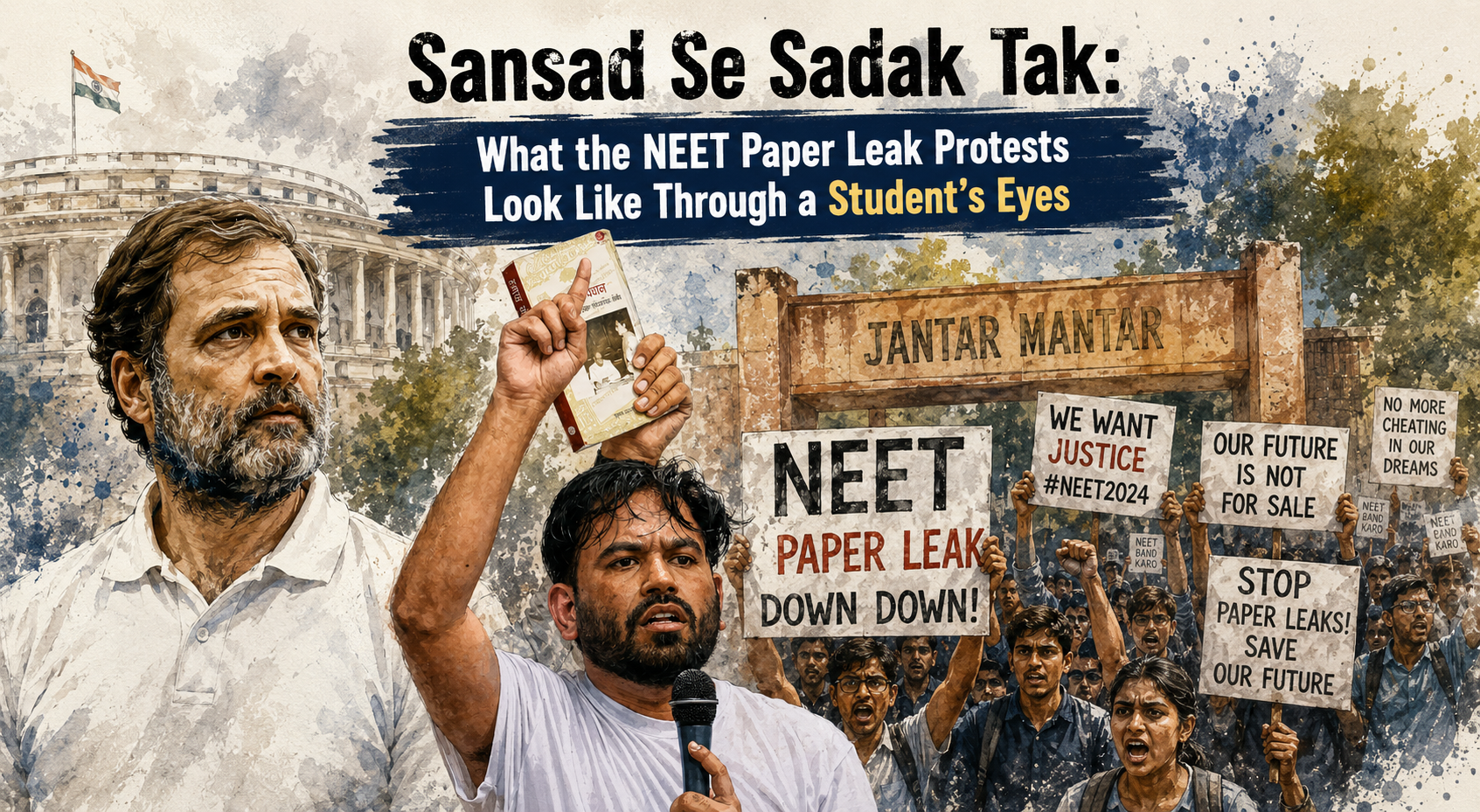
For weeks now, Jantar Mantar has looked less like a Delhi landmark and more like an extension of India’s classrooms and coaching centres. Placards instead of textbooks, slogans instead of syllabi — but the same anxious, exhausted faces that usually show up at NEET and CBSE exam centres. What began as anger over an exam paper leak has, over the course of a single monsoon, grown into one of the most visible student movements India has seen in years. This piece tries to lay out how we got here, where things stand today, and — as students ourselves — what we think a fair way forward looks like.
How We Got Here: A Timeline
- May 2026 — Reports emerge of irregularities in the NEET-UG 2026 examination, alongside concerns over CBSE’s on-screen marking process, affecting lakhs of aspirants who had spent years preparing for one exam.
- Early June 2026 — A youth-led group called the Cockroach Janta Party (CJP), founded by digital strategist Abhijeet Dipke, begins organising protests at Jantar Mantar alongside established student bodies like SFI, AISA and AISF, demanding accountability and the resignation of Union Education Minister Dharmendra Pradhan.
- June 28, 2026 — Ladakhi engineer-activist Sonam Wangchuk, known nationally for his education and climate activism, joins the protest site and begins an indefinite hunger strike in solidarity with the students, alongside several young AISA members.
- Mid-July 2026 — As Wangchuk’s hunger strike stretches past two weeks and his condition worsens, opposition leaders publicly urge him to end the fast, even as the protest camp grows and draws national attention.
- July 18–19, 2026 — Police remove Wangchuk from the protest site early on a Saturday morning, citing his deteriorating health; protesters allege he was taken away by force. Rather than winding the movement down, the incident brings a fresh wave of supporters to Jantar Mantar.
- July 20, 2026 — Thousands attempt a “Chalo Sansad” march toward Parliament. Delhi Police respond with a lathi charge and, by several accounts, tear gas; the CJP alleges volunteers were injured. Delhi Police maintain they were only maintaining public order.
- July 21, 2026 — On the second day of Parliament’s Monsoon Session, Leader of Opposition Rahul Gandhi, Priyanka Gandhi Vadra, Congress president Mallikarjun Kharge and INDIA bloc leaders are briefly detained while marching toward the Prime Minister’s residence, demanding a Parliament debate on the issue. Proceedings in both Houses are repeatedly adjourned amid opposition sloganeering.
Where Things Stand Right Now
As of this week, the picture is still unfolding. Protesters remain camped at Jantar Mantar, with the CJP saying the agitation will only intensify. A five-hour meeting between CJP representatives and Union Health Minister J.P. Nadda reportedly ended without a resolution, and both sides are now waiting on the other to make the next move. The opposition continues to press for a full Parliament debate and the Education Minister’s resignation; the government has accused the opposition of using students to disrupt the Monsoon Session. Parliament itself has barely functioned — sessions have opened and adjourned within minutes on multiple days.
Caught in the middle of all this political back-and-forth is a fairly simple, non-political demand: students want to know that the exam that decides their future was conducted fairly, and they want a transparent investigation into what went wrong.
The View From the Student Side
Talk to students at the protest site, and the politics around it — the CJP, the opposition, the government’s response — often feels secondary to something more personal: the fear that years of preparation and family sacrifice could be undone by a system they had no control over. For many, this is their first time engaging with a political protest at all, and it hasn’t come out of ideology — it’s come out of exhaustion and worry about their own futures.
Some of that comes through in how younger protesters describe why they’ve shown up in the first place. A number of school students at the site say they hadn’t followed Sonam Wangchuk’s activism before this — but once they saw him fasting for students he’d never met, several described feeling like someone was finally standing up for them the way they wished the system would.
That’s really the throughline of the student voice in this movement: not anger for its own sake, but a demand to be taken seriously. Most students at Jantar Mantar aren’t asking for any single leader’s resignation as an end in itself — they’re asking for guarantees that this doesn’t happen to the next batch of aspirants, and for some acknowledgment of what the last two months have cost them in preparation time, mental health, and trust.
A Roadmap Worth Considering
Whatever one’s view of how the protests have been organised or handled, a few steps forward seem hard to argue with:
- An independent, transparent investigation into the NEET-UG 2026 paper leak and the CBSE on-screen marking irregularities, with findings made public rather than settled behind closed doors.
- A dedicated Parliament debate on examination integrity — not as a political football, but as a genuine policy conversation involving the NTA, CBSE, and education ministry.
- Structural safeguards for future exams — stronger paper-security protocols, technology-based leak prevention, and third-party audits of exam conduct, so this isn’t a conversation India has to keep having every admission cycle.
- A direct, de-politicised channel for student grievances — whether through the NTA, the education ministry, or an independent ombudsman — so students don’t have to escalate to hunger strikes and street marches just to be heard.
- De-escalation on the ground — for the protests to remain peaceful and for policing of student demonstrations to stay proportionate, so the conversation stays on exam reform rather than on the optics of confrontation.
None of this requires taking a side in the larger political contest playing out in Parliament. It just requires remembering that behind the placards, the hashtags, and the breaking-news tickers are lakhs of students who did everything they were told to do — study hard, show up, compete fairly — and are simply asking the system to have done the same.
This piece reflects the perspective of students following the NEET-UG 2026 protests as the situation continues to develop; details may change as the Monsoon Session progresses.