Last updated: 21 November 2026
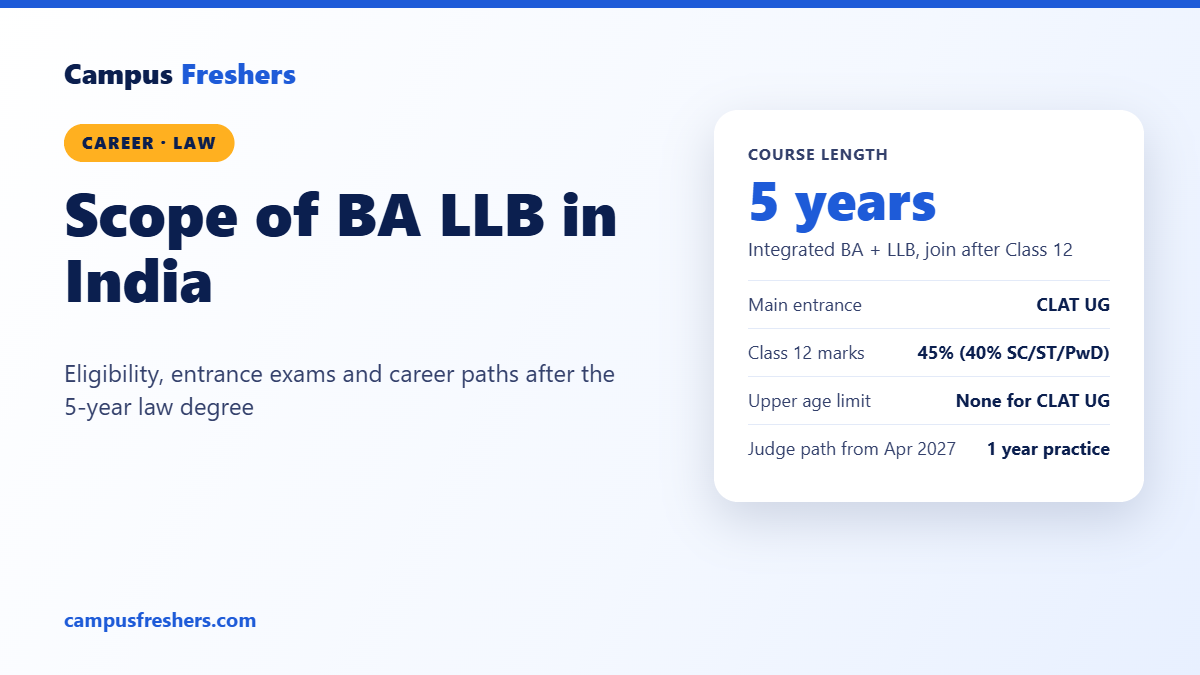
Quick answer: BA LLB is a five-year integrated law degree you can join right after Class 12. It leads to careers in litigation, corporate law firms, company legal teams, the judiciary, policy and teaching. Admission to the top National Law Universities is through CLAT, which needs 45% in Class 12 (40% for SC, ST and PwD) and has no upper age limit.
Key highlights
- Course length: five years, integrated (arts subjects plus law), joined after Class 12
- Main entrance: CLAT UG, used by 26 National Law Universities; CLAT 2027 is on 6 December 2026
- CLAT UG eligibility: 45% in Class 12 (40% for SC, ST and PwD), no upper age limit
- To practise in court: enrol with a State Bar Council and clear the All India Bar Examination (AIBE)
- Judiciary: from 1 April 2027, new Civil Judge (Junior Division) notifications need at least one year of practice, after a Supreme Court order of 21 August 2026
What is BA LLB and how is it different from a 3-year LLB?
BA LLB combines a Bachelor of Arts with a Bachelor of Laws in one five-year programme. In the first couple of years you study subjects like political science, history, sociology and economics alongside introductory law papers. Over the next years the focus shifts to core law: constitutional law, contracts, torts, criminal law, property law, family law, company law, evidence and procedure, along with moot courts and internships.
The three-year LLB is meant for people who already hold a graduation degree. If you are sure about law after Class 12, the five-year route saves a year compared with doing a three-year BA first and then a three-year LLB, and it gives you more years of internships before you graduate.
| Point | BA LLB (5-year) | LLB (3-year) |
|---|---|---|
| When you join | After Class 12 | After graduation |
| Total time after Class 12 | 5 years | 6 years (3-year degree plus 3-year LLB) |
| Main entrance | CLAT UG, AILET and university tests | University or state-level tests |
| Best for | Students sure about law early | Graduates who choose law later |
Who is eligible for BA LLB?
For the National Law Universities, the rules are set by CLAT. According to the Consortium of NLUs, CLAT 2027 UG candidates need at least 45% marks in Class 12 or equivalent, or 40% for SC, ST and PwD candidates. There is no upper age limit, and students appearing for Class 12 in March or April 2027 can also apply, as long as they show their pass certificate at admission.
Other universities and private law schools set their own cut-offs and entrance tests, so check the admission page of each college you are targeting. You can come from any stream: arts, commerce or science students all take law.
Which entrance exams lead to BA LLB?
- CLAT UG: conducted by the Consortium of NLUs for admission to 26 participating NLUs. The paper has 120 questions in two hours across English, Current Affairs, Legal Reasoning, Logical Reasoning and Quantitative Techniques.
- AILET: NLU Delhi runs its own entrance test and does not admit through CLAT.
- University and private law school tests: many state and private universities hold their own exams or accept CLAT scores. Several other colleges and organisations also use CLAT scores, according to the Consortium.
What is the scope of BA LLB in India?
Law is one of the few degrees that opens doors in courts, companies, government and the social sector at the same time. Here are the main paths and what each one needs:
| Career path | What the work looks like | What you need beyond the degree |
|---|---|---|
| Litigation (advocate) | Arguing cases in district courts, High Courts or the Supreme Court | Enrolment with a State Bar Council, clearing AIBE, years of practice under a senior |
| Corporate law firm | Contracts, mergers, compliance, disputes for businesses | Strong internships, drafting skills, good academic record |
| In-house counsel | Legal work inside a company, bank or startup | A few years of firm or litigation experience usually helps |
| Judiciary | Civil Judge (Junior Division) and higher judicial posts | State judicial service exam, plus the practice rule explained below |
| Policy, research and NGOs | Law reform, rights work, think tanks, legal aid | Research and writing skills, often an LL.M. or fellowship |
| Teaching and academia | Teaching law at universities | LL.M., plus UGC NET in Law for many posts |
| Legal journalism and publishing | Reporting on courts and legal developments | Writing skills and a clear understanding of procedure |
Pay varies a lot by path, city and the law school you graduate from, so be careful of any single salary figure you see online. Litigation often starts slow and grows with reputation, while firm jobs usually pay a fixed salary from the start.
What is the new rule for becoming a judge after BA LLB?
This is the biggest recent change for law students who want to join the judiciary. In May 2025, the Supreme Court brought back a three-year Bar practice requirement for Civil Judge (Junior Division) posts. On 21 August 2026, a review bench eased that rule, according to reports by Supreme Court Observer, LiveLaw and The Leaflet:
- For recruitment notifications up to 31 March 2027, law graduates can apply without the three-year practice requirement.
- For notifications on or after 1 April 2027, candidates need at least one year of actual practice, backed by a Certificate of Practice.
- Selected candidates go through one year of training at the State Judicial Academy and one year of clerkship before taking charge, as reported.
State High Courts and Public Service Commissions publish the actual rules for each exam, so always read the official notification of your state before you plan.
Is BA LLB the right course for you?
Ask yourself these questions honestly before you start CLAT coaching:
- Do you enjoy reading? Law means reading long judgments, statutes and case files every single week.
- Can you argue with logic, not just emotion? Both litigation and drafting reward clear, structured thinking.
- Are you patient? Litigation in particular takes years to build. Early income can be modest.
- Do internships excite you? Most of your real learning, and your first job, comes from internships during college.
- Are you comfortable with public speaking? If not, corporate, policy and research roles may suit you better than courtroom work, and that is perfectly fine.
If most answers are yes, start with the basics: read a newspaper daily, practise reading comprehension, and attempt one full CLAT mock to see where you stand.
Frequently asked questions
Can a science or commerce student do BA LLB?
Yes. BA LLB is open to students from any stream who meet the Class 12 marks requirement. CLAT does not test science or accounts, so your stream does not give you an advantage or disadvantage.
Is there an age limit for BA LLB admission through CLAT?
No. The Consortium of NLUs says there is no upper age limit for CLAT UG. Individual universities that do not use CLAT may have their own rules, so check with them.
What is the difference between BA LLB, BBA LLB and B.Com LLB?
All three are five-year integrated law degrees and lead to the same LLB. The difference is the non-law part: BA LLB covers social sciences, BBA LLB covers management, and B.Com LLB covers commerce and accounts. Pick based on whether you lean towards litigation and policy or corporate work.
Can I practise law right after finishing BA LLB?
You need to enrol with a State Bar Council and clear the All India Bar Examination conducted by the Bar Council of India. Final-semester students without backlogs have been allowed to register for recent AIBE cycles, according to the BCI notice.
Can I become a judge directly after BA LLB?
For Civil Judge (Junior Division) notifications up to 31 March 2027, fresh law graduates can apply, as per the Supreme Court’s August 2026 order. From 1 April 2027, you will need at least one year of practice. Always check your state’s official notification.
Is BA LLB worth it in 2027?
It is worth it if you genuinely like reading, arguing and writing, and you are ready to put in effort during internships. The degree gives you a wide choice of careers, but results depend heavily on the skills you build in college, not just the name on your certificate.
Official links and sources
- CLAT 2027 official portal (Consortium of NLUs)
- CLAT 2027 UG eligibility
- CLAT 2027 UG question paper format
- All India Bar Examination notification (Bar Council of India)
- Supreme Court Observer on the practice rule for Civil Judge posts, 21 August 2026
- LiveLaw report on the practice requirement waiver till March 2027