For decades, the study-abroad conversation in Indian households had a predictable script. The dream was the US. The backup was the UK, Canada, or Australia. Everything else was an afterthought.
In 2026, that script has quietly been rewritten.
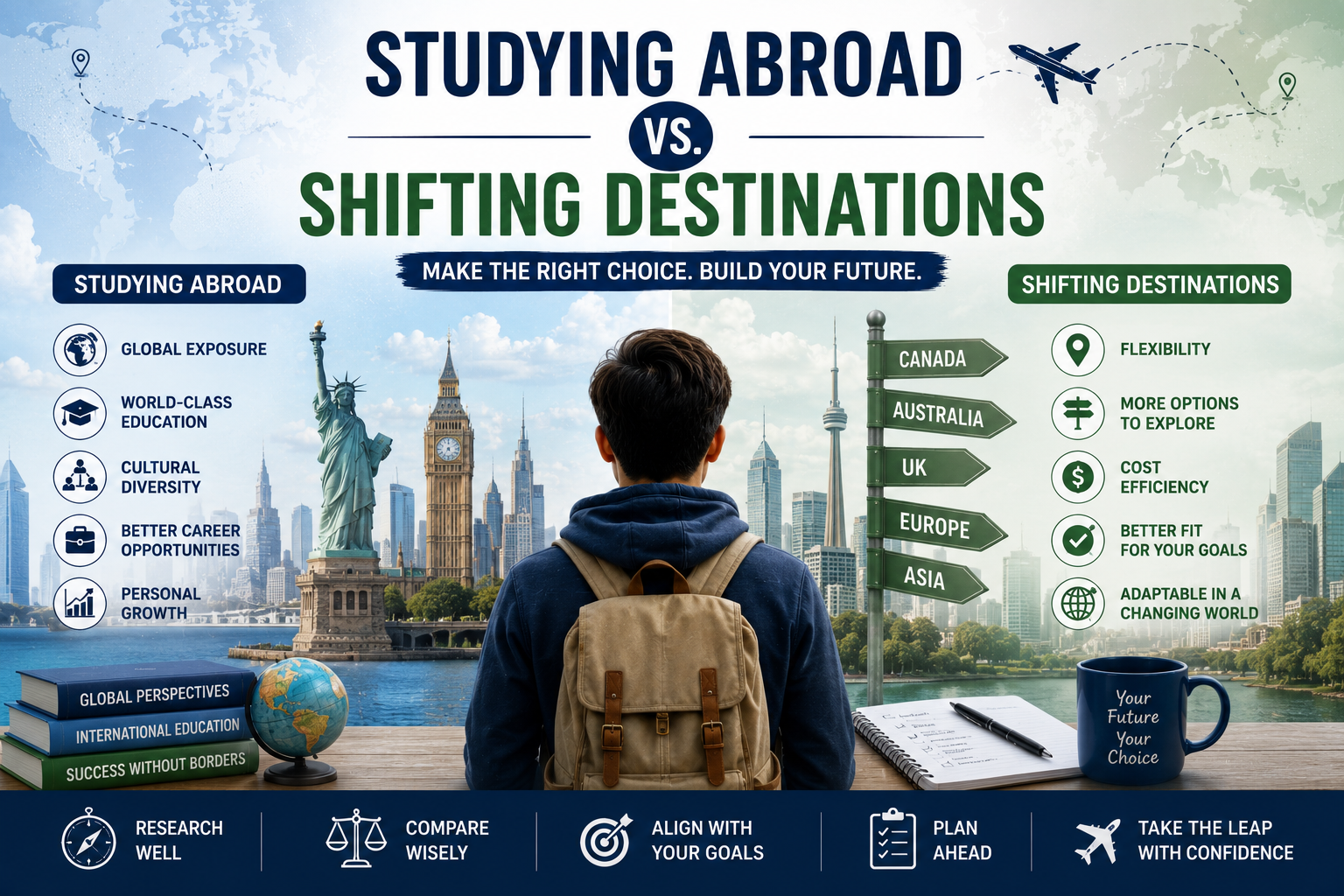
Indian student enrolment in the US has dropped by roughly 10%, and the reasons aren’t mysterious — rising costs, tighter visa policies, and a sense of uncertainty have pushed students to think differently. But here’s the more interesting part of the story: they aren’t giving up on global education. They’re getting smarter about it. A new generation of applicants is treating studying abroad less like a status symbol and more like an investment — weighing tuition, job prospects, and visa pathways with genuine care.
This guide breaks down where the smart money is heading in 2026, why each destination is rising, and — crucially — how to fund it, with the actual scholarships and official portals you’ll need.
What Changed: The 2026 Reality Check
A few shifts collided to reshape student choices this year:
- Costs climbed everywhere. Tuition, living expenses, and visa fees rose 5–10% across the traditional “Big Four” destinations.
- Policies tightened. Canada reduced study-permit targets and reworked its post-graduation work permit rules. Australia raised visa fees and tightened age limits. The UK introduced new English-language requirements.
- Students got strategic. The era of “I’ll go there because my cousin lives there” is fading. Today’s applicants think like investors — comparing total cost, return on investment, and the odds of landing a job and staying on afterward.
The result isn’t retreat. It’s diversification. Students are discovering that some of the best value in global education sits well outside the obvious choices.
The Rising Stars: Where Indian Students Are Heading in 2026
🇩🇪 Germany — The Undisputed Value King
Germany has gone from “alternative option” to a top choice, especially for STEM, engineering, and research students. The headline reason is simple: most public universities charge little to no tuition, even for international students. Your total annual cost (mostly living expenses) often lands in the ₹8–12 lakh range — a fraction of the US.
The pathway after graduation is just as appealing: an 18-month job-seeker visa to find work, transitioning to the EU Blue Card and a fast track toward permanent residency. For engineering, automotive, AI, and manufacturing students, the industry links are exceptional.
Best for: STEM and research students who want world-class education with minimal financial risk.
🇸🇬 Singapore — Quality and Proximity to India
Singapore offers world-ranked universities and unmatched access to Asian financial and tech markets — all within a short flight of home. Tuition is higher (roughly SGD 25,000–50,000/year), but the trade-offs are strong industry exposure, a familiar cultural environment for many Indian students, and a stable, safe setting. In the QS 2026 subject rankings, the National University of Singapore (NUS) climbed to joint 4th globally in Computer Science — the highest-ranked non-US/UK university for CS.
Best for: Students prioritising rankings, career networking, and staying close to home.
🇦🇺 Australia — Tech, Healthcare, and Strong Employability
Despite higher fees, Australia remains a magnet — increasingly for IT, healthcare, and research. Its innovation-focused visa routes now give priority to graduates skilled in AI, data, and sustainability. Combine that with high safety standards and a 2–4 year post-study work visa (with special benefits under the India–Australia agreement), and the value case holds.
Best for: Tech, data, and healthcare students who want a clear work-and-stay pathway.
🇨🇦 Canada — Still Strong, But Be Strategic
Canada hasn’t fallen out of favour — it just demands sharper planning now. With reduced permit targets and reworked work-permit rules, the students who win are those pursuing in-demand fields like specialised STEM, healthcare, and skilled trades. The upside remains real: up to three years of post-graduation work and a relatively clear route to PR through the Canadian Experience Class.
Best for: Students in high-demand fields willing to research the rules carefully before committing.
Worth Watching: France, New Zealand, South Korea, UAE & Ireland
The diversification doesn’t stop there. France offers affordable, increasingly English-taught programs. New Zealand is prized for stable immigration policy and a clear post-study work route. South Korea is rising fast for tech-focused students. The UAE offers tax-free salaries, branch campuses of top global universities, and a pathway to the 10-year Golden Visa. Ireland gives graduates 1–2 years to find work. The map of “smart” study-abroad destinations has never been wider.
Best Countries to Study Abroad: Think Like an Investor, Not a Tourist
Before falling in love with a country, run it through four practical filters:
- Total cost, not just tuition. A “free tuition” country with high living costs may total more than a “high tuition” country with scholarships. Add it all up honestly.
- Post-study work and PR pathways. For most Indian students, a job abroad is the real goal. Prioritise countries with clear, generous post-study work visas.
- Your specific field. Rankings matter most at the subject level, not the overall university table. A school ranked 50th overall might be top-10 in your exact discipline — check the QS subject rankings for your field.
- Return on investment. Most students recover their education cost within 3–5 years through higher global salaries. Map that math before you sign anything.
Funding the Dream: Scholarships, Aid, and Where to Find Them
Here’s a myth worth demolishing: studying abroad is not only for wealthy families. There are reportedly over 1,000 scholarships and grants available to Indian students in 2026 — and many go unclaimed every year simply because students don’t know they exist. That’s money left on the table.
The Big-Name Scholarships to Target
These are the marquee, often fully funded awards (covering tuition, living costs, and sometimes travel):
- DAAD Scholarships (Germany) — the gold standard for funded study in Germany, especially for Master’s and research.
- Chevening Scholarships (UK) — the UK government’s flagship fully funded award for one-year Master’s.
- Fulbright-Nehru Fellowship (USA) — prestigious funding for Indian students and scholars heading to the US.
- Australia Awards (Australia) — government scholarships covering tuition, living, and travel.
- Vanier Scholarships (Canada) — high-value awards for doctoral students.
Don’t Overlook These Categories
Cast a wide net across all scholarship types, not just one:
- University-specific scholarships linked directly to your admission offer (often the easiest to win — apply to schools that offer them).
- Merit-based (academic, leadership) vs need-based (financial background) awards.
- Subject-specific scholarships for STEM, business, arts, or research.
- Research assistantships and fellowships — for Master’s and PhD students, these can cover costs and pay a stipend.
Official Portals and Resources Worth Bookmarking
Go straight to the source rather than relying on second-hand listings. These official and government portals are the most reliable starting points:
- DAAD — daad.de — official German academic exchange service and scholarship database.
- Campus France — campusfrance.org — France’s official agency for studying there, including funding.
- Chevening — chevening.org — the UK’s official scholarship portal.
- IRCC (Canada) — canada.ca/en/immigration-refugees-citizenship — official source for Canadian study permits and rules.
- Australia Department of Home Affairs — homeaffairs.gov.au — official visa and student information.
- Study in Finland — studyinfinland.fi — Finland’s official study portal.
- QS Rankings — topuniversities.com — for checking subject-level rankings in your field.
- EducationUSA — educationusa.state.gov — official US government advising network for international students.
A planning tip that saves lakhs: Most major scholarships have deadlines 8–12 months before the intake. Start your scholarship research the moment you begin shortlisting universities — not after you’ve been admitted. The students who fund their education well are almost always the ones who started early.
Smart Tips to Lower Your Costs (Beyond Scholarships)
Scholarships are only one lever. Stack these too:
- Choose low-tuition countries strategically — Germany, France, and several European and Asian hubs dramatically cut your base cost.
- Use legal part-time work — most study destinations allow students to work part-time, which can meaningfully offset living expenses.
- Factor in post-study earning — students who combine scholarships, part-time work, and a strong post-study job recover their investment fastest.
- Apply to multiple universities — more admission offers means more shots at university-linked scholarships.
- Talk to verified counsellors and alumni — but cross-check everything against official portals before paying any fee.
Frequently Asked Questions
Is studying abroad still worth it for Indian students in 2026? For most students, yes — provided you choose strategically. The return on investment is typically recovered within 3–5 years through higher global salaries and faster career growth, especially in tech, healthcare, and engineering. The key is picking countries with low costs, strong job demand, and clear post-study work options.
Which country offers the best value for money? Germany consistently leads on pure value, thanks to free or minimal tuition at public universities plus an 18-month post-study job-seeker visa. The UAE is also rising fast for its tax-free salaries and Golden Visa pathway.
Can I study abroad fully funded? Yes. Several scholarships offer 100% funding — including DAAD (Germany), Chevening (UK), Fulbright-Nehru (USA), and Australia Awards — typically covering tuition, living expenses, and travel. Competition is high, so apply early and to several.
Which destination has the best post-study work options? Canada (up to 3 years), Australia (2–4 years), Germany (18-month job-seeker visa leading to the EU Blue Card), and New Zealand (up to 3 years) all offer strong post-study work pathways — though always verify the current rules on official government portals, as policies shift.
When should I start applying for scholarships? As early as possible — ideally 8–12 months before your intended intake. Many fully funded scholarships close well before university application deadlines, and late applicants miss out on the best awards.
The Bottom Line
The story of 2026 isn’t that Indian students are abandoning the dream of studying abroad — it’s that they’re pursuing it more wisely than ever. The US dropping ~10% isn’t a loss; it’s a rebalancing toward destinations that offer better value, clearer career outcomes, and smarter financial returns.
The opportunities are wider than they’ve ever been, and the funding is more accessible than most families realise. The students who thrive won’t be the ones who chase prestige — they’ll be the ones who research carefully, apply early, and choose the path that fits their field, their budget, and their goals.
Your destination is out there. Go find the one that’s right for you — not the one everyone else assumed you’d pick.
Always verify visa rules, fees, and scholarship deadlines on official government and university portals before making decisions, as policies in 2026 are changing rapidly. For more study abroad guides, scholarship updates, and career resources built for Indian students, explore Campus Freshers.